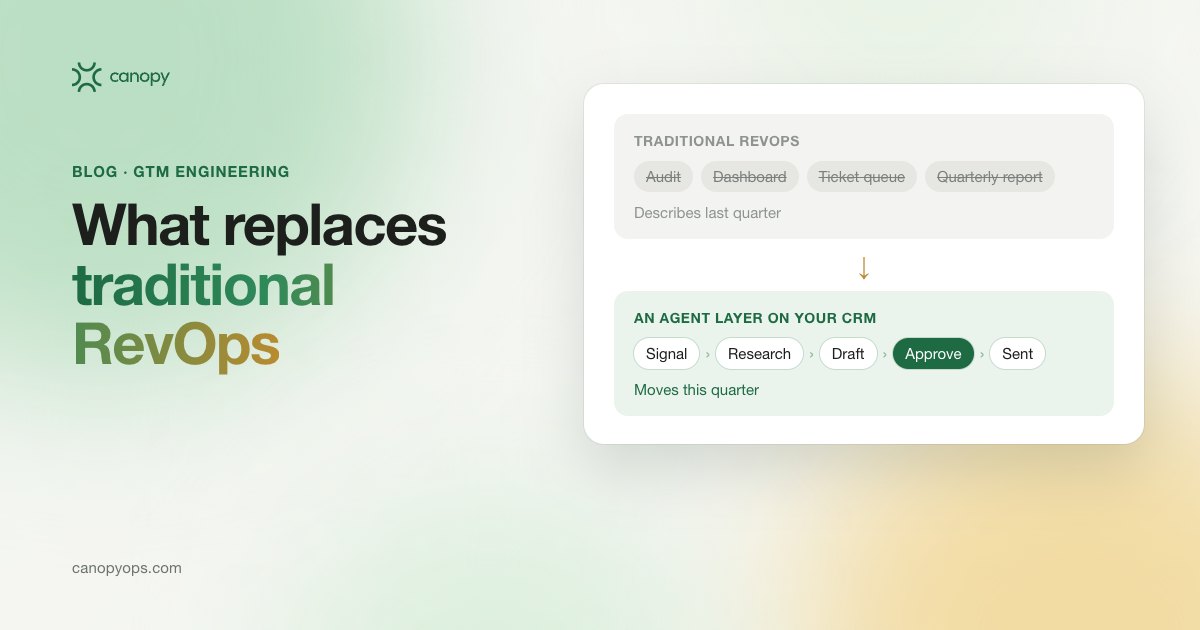
Traditional RevOps delivers audits, CRM cleanups and dashboards that describe the funnel without moving it. GTM engineering replaces it, and the version I'd build today is an agentic revenue system: AI agents inside HubSpot or Salesforce that do the follow-up, outreach and renewal work, with people approving each send and owning the numbers.
Key takeaways on what replaces traditional RevOps
- Traditional RevOps work, the audit, the cleanup and the dashboard, reports where revenue leaks without closing the leak.
- GTM engineering treats the revenue engine as a production system to build and measure.
- An agentic revenue system puts AI agents on top of the CRM a team already owns, HubSpot or Salesforce.
- People stay accountable, because every agent send is approved until the team chooses otherwise.
- The quickest test of any RevOps deliverable is whether a baselined KPI moved after it shipped.
Why traditional RevOps stopped moving revenue
For years, traditional RevOps has delivered the same three things: an audit, a cleanup and a dashboard. The tooling got shinier. The playbook never changed. Keep the CRM tidy, keep the reports accurate, send the invoice. On paper the revenue operations function is broader. HubSpot's RevOps guide (updated July 2026) describes it as aligning sales, marketing and customer success around shared data, processes and goals. Forrester (2024) goes further and calls revenue operations "a highly configured, iterative commercial execution strategy." In most CRMs we've worked in, RevOps work stops before the execution part.
The technology around RevOps sprinted in those years. AI can now research an account, write a personal message, read a call transcript and act inside a CRM. In 2021, Gartner predicted that 75% of the highest-growth companies would deploy a RevOps model by 2025. RevOps got its seat on the org chart and kept shipping the same deliverables, and the gap between what a revenue team could run and what it ships keeps widening.
The admin trap inside most revenue teams
The problem in most revenue teams is architecture, and growth stalls because of it. The typical setup was built piece by piece over years: tools bolted on at each stage, data that's technically present but practically unusable, and reporting nobody fully trusts. Leads leak between marketing and sales. Follow-up is manual and inconsistent. Reps spend their selling time on admin. Salesforce's 2026 State of Sales report, a vendor survey of 4,050 sales professionals, found the average seller spends 40% of their time selling, and 51% of sales leaders using AI say disconnected systems are slowing their AI initiatives.
Why another RevOps dashboard doesn't fix the leak
Traditional RevOps answers the admin trap by describing it. Another audit, another field-mapping exercise, another dashboard that reports the leak without fixing it. The operation gets tidier and revenue stays where it was. A dashboard can show which deals have no next step. Someone still has to write each follow-up, and in most teams that someone is a rep already behind on the week.
Why buying AI hasn't fixed RevOps
Buying AI hasn't closed the execution gap on its own. McKinsey's 2026 State of AI survey of 1,719 participants found only 37% say AI has contributed positively to their organization's EBIT, about the same as in 2025. The models can already write and research. What's missing is someone wiring them into the work between the insight and the revenue: the follow-up after the call, the deal that went quiet, the renewal nobody chased.
How GTM engineering changed the RevOps job
GTM engineering treats the revenue engine the way an engineering team treats a production system, as something to build and improve against measurable outputs. As I use the term, the job is building automated revenue systems with AI, data enrichment and workflow automation, and answering for what they produce. In practice, GTM engineering ships work that traditional RevOps rarely does:
- Every engagement ships working infrastructure, such as enrichment that runs on its own and first touches drafted from account research.
- Follow-up comes from what was said on the call.
- The intelligence lives in the CRM, writing to the records reps already use, with no sidecar tool and no extra login.
- Every build is tied to a KPI such as speed-to-lead, reply rate or net revenue retention, baselined before and measured after.
What replaces traditional RevOps: an agentic revenue system
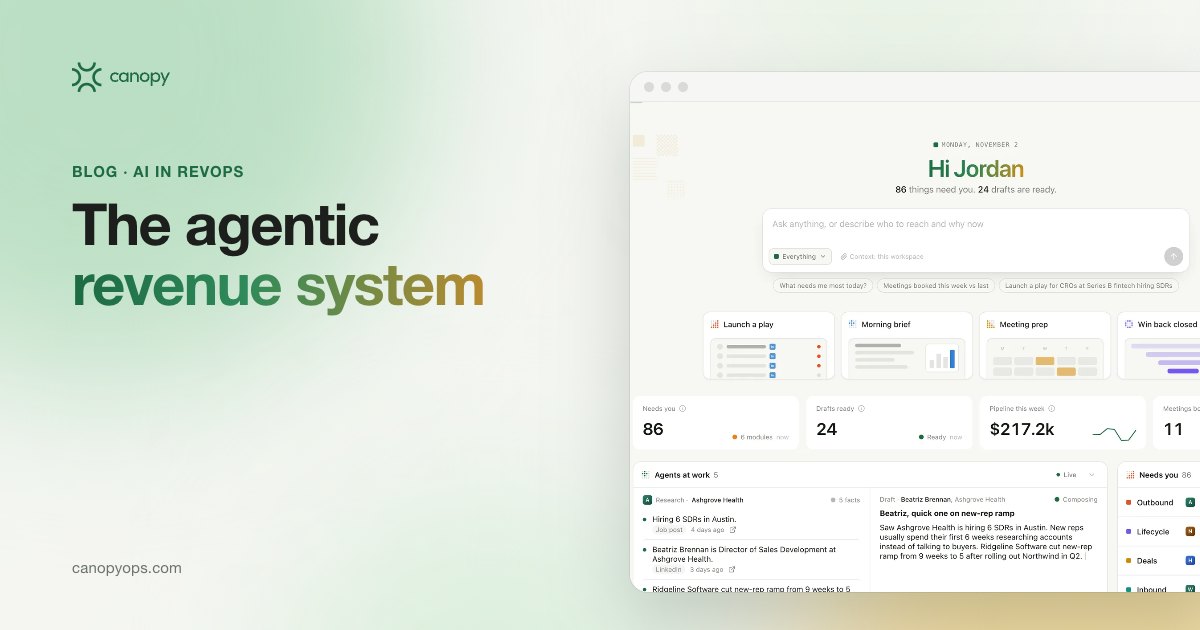
An agentic revenue system is GTM engineering with AI agents doing the execution, and it's what we built Canopy to be. We unify your systems, build an agent layer on top, and make it the master platform for everything in your CRM. Our team runs it with you, and we own the results. HubSpot or Salesforce stays the source of truth, each client runs on a private instance, and every send, reply, booked meeting and lifecycle stage change is written back to the CRM. Agents work in workspaces, from Outbound prospecting to churn and renewal signals in Customers. Each week, Learnings tests new message versions against a holdout and proposes the winning version with its evidence, which a person applies in one click. For RevOps leaders, Canopy's revenue operations software puts reporting, data quality and agent permissions in one place.
How one agent handles a sales follow-up end to end
The Canopy Deals workspace shows the difference in a single job, which our guide to AI sales follow-up covers in full. After a sales call, the Deals agent reads the call notes, drafts the next step and the follow-up email, and puts both in front of the rep. Canopy Deals is locked to Approve to send, so the rep owns every word and nothing goes out without them. Each call's summary, commitments and next steps sit on the deal in Canopy beside the drafted follow-up, so the gap a RevOps dashboard would have flagged already has a draft waiting to close it. Reps stop rebuilding calls from memory, and the pipeline report reflects follow-ups that happened.
Who approves what the agents send
Canopy agents run under three send modes: Draft only, Approve to send and Automatic. Every send is approved until the client chooses otherwise. Send modes are set per workspace in Agent control, and every change is logged with who made it and when. Customers runs on Draft only by default, so CSMs decide whether and when anything goes out. Lifecycle can move to Automatic, and its agents write inside the offers and voice rules the team approved. Message changes wait for a person to accept them, and every agent action, including who approved each send, can be downloaded as a CSV file.
Traditional RevOps vs GTM engineering vs an agentic revenue system
Traditional RevOps, GTM engineering and an agentic revenue system differ most on who does the work and who answers for the result.
| Question | Traditional RevOps | GTM engineering | Agentic revenue system |
|---|---|---|---|
| Main output | Audits, cleanups and dashboards | Automated workflows and enrichment | Agents doing outreach and follow-up |
| Who does the revenue work | Reps, after the project ends | Reps, with workflows doing parts of it | Agents, under approval, run by GTM Engineers and the client's team |
| Where it lives | The CRM plus reporting tools | The CRM plus enrichment and workflow tools | An agent layer on HubSpot or Salesforce |
| How success is measured | Data accuracy and report adoption | A KPI per build | Replies, meetings, pipeline and retention against a baseline |
| How it improves | At the next audit | When an engineer rebuilds a workflow | Weekly tests against a holdout, with the winner applied once a person accepts it |
| Who owns the result | The client | The client | Shared: Canopy GTM Engineers answer for the numbers |
Why outsourced RevOps teams struggle to build systems
Outsourced RevOps help gets less precise as it grows. Firms scale by templating the work: the same audit deck, the same nurture flows, the same dashboards, shipped by whoever is free. A revenue system needs a small team where the people who design the strategy are the same people inside your CRM every week.
Handover is where many outsourced RevOps builds fail. The test of any build is whether your team can run, improve and scale it after handover. Canopy keeps the agents on the CRM you own, you set the send modes, and GTM Engineers stay in the weekly review through a 90-day adoption period after the 30-day build.
A test to run on your own RevOps operation
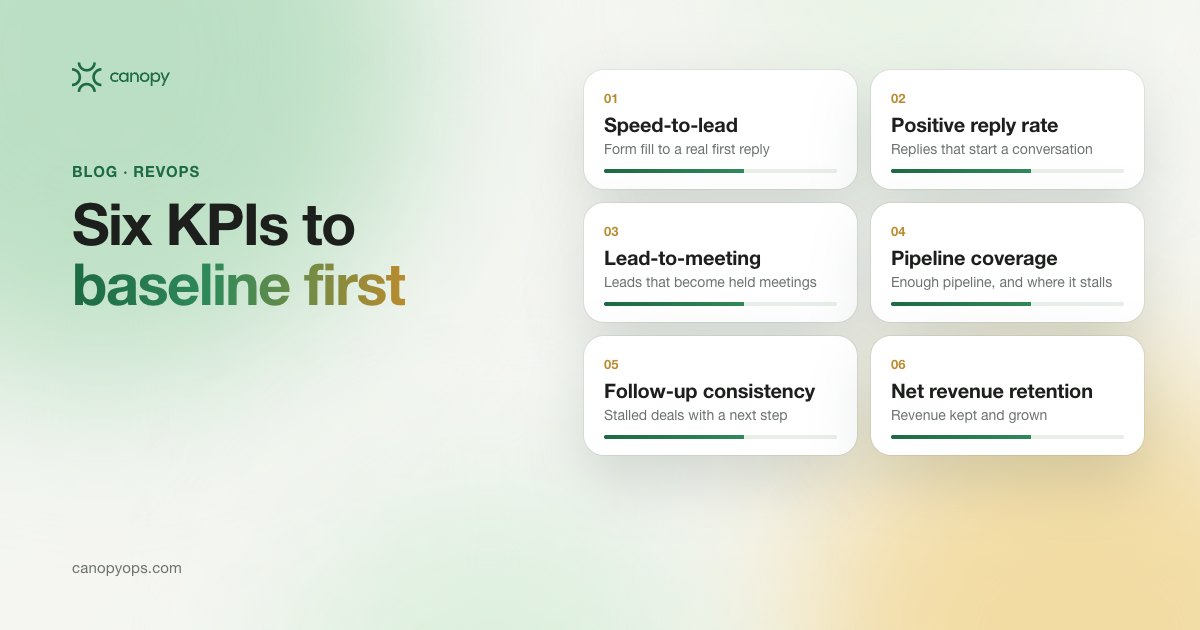
Ask one question of every RevOps deliverable you've paid for in the last year: did it describe the funnel, or did it move the funnel? Moving the funnel means a number you baselined before the work changed after it, so start with the six KPIs to baseline before you buy another GTM tool. Any of these signs means the operation still runs on reporting:
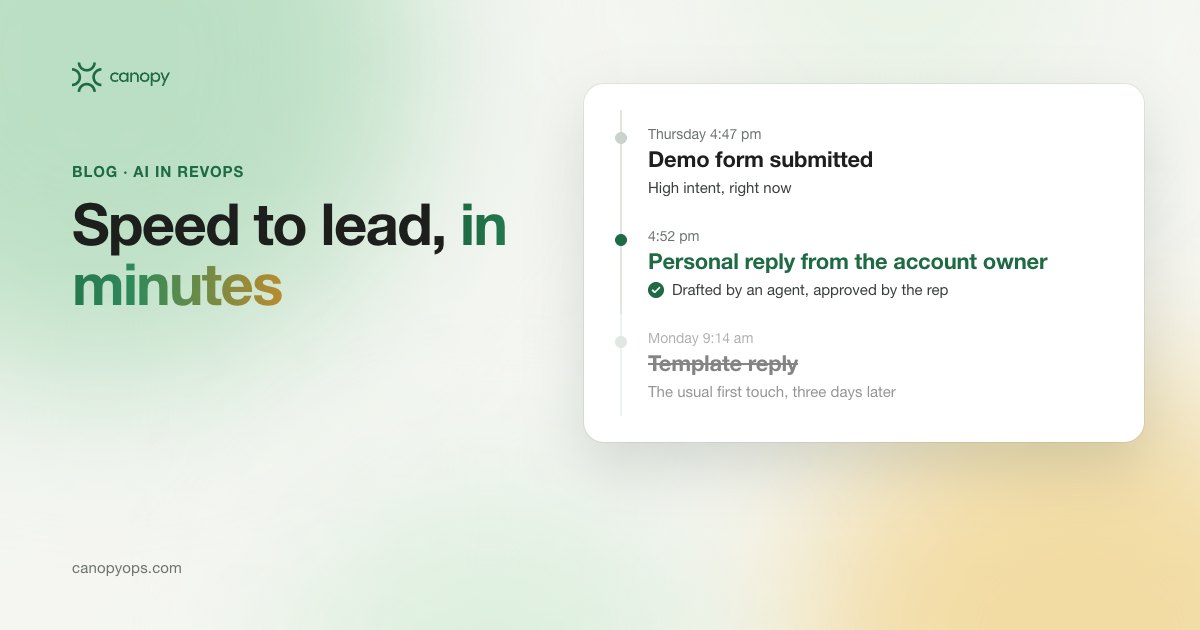
- A new lead waits hours for a first touch (see agentic inbound and speed-to-lead).
- Reps write their own follow-up from memory after calls.
- Deals sit with no next step until the pipeline review catches them.
- Churn still surprises the customer success team.
The parts to build a revenue system exist today, and most of the industry isn't building them yet. We are. That's the whole reason Canopy exists.
Common questions about RevOps and what replaces it
What replaces traditional RevOps?
GTM engineering replaces traditional RevOps, and its most complete form is an agentic revenue system. AI agents work inside HubSpot or Salesforce on outreach, follow-up, lifecycle email and renewal prep, in place of audits and dashboards that only describe the funnel. People approve what the agents send, and a named team answers for pipeline and retention.
Is RevOps dead?
The RevOps goal of aligning sales, marketing and customer success on shared data still holds. What I'd retire is the deliverable model, where an engagement ends at an audit, a cleaned CRM or a dashboard and the follow-up work falls to reps who are already stretched. RevOps thinking belongs inside execution, in the system that drafts and sends the follow-up.
What's the difference between RevOps and GTM engineering?
RevOps aligns sales, marketing and customer success around shared data, processes and goals, and traditionally delivers process design, reporting and CRM administration. GTM engineering builds the automated systems that do revenue work, using AI, data enrichment and workflow automation. A RevOps team decides how the revenue engine should run, and GTM engineering builds the parts that run it.
Will AI agents take over the RevOps team's job?
No. In an agentic revenue system, agents draft and send the repetitive work, and people decide what goes out and answer for the results. The RevOps team shifts to setting the rules agents follow, choosing send modes, reviewing weekly test results and keeping CRM data clean enough for agents to act on.
Do we have to leave HubSpot or Salesforce to use an agentic revenue system?
No. Canopy runs as an agent layer on top of the CRM you already own, and HubSpot or Salesforce stays the source of truth. Canopy reads from the CRM and writes every send, reply, booked meeting and lifecycle stage change back to it, so reports, owners and history stay where your team already works. Each client runs on a private instance.
How do you know whether RevOps work moved revenue?
Baseline the KPIs before the work starts and measure the same KPIs after. For outbound, that means reply rate, positive reply rate, meetings booked and pipeline, never open rate. Lifecycle email adds open rate, click rate and click-to-open rate. Across the whole engine, speed-to-lead, pipeline conversion and net revenue retention show whether the funnel moved or only got described more clearly.
Why hasn't AI improved revenue for most companies yet?
Most companies bought AI tools without wiring them into the work that produces revenue. In McKinsey's 2026 State of AI survey, only 37% of respondents said AI had contributed positively to their organization's EBIT. The gap sits in execution: follow-up after calls, deals that go quiet and renewals nobody chases, which is where agents inside the CRM do their work.
How long does it take to set up an agentic revenue system?
Canopy puts the first workspace live after a 30-day build, which starts from a revenue workshop in week 0 that maps the stack and agrees the baseline KPIs. The build is followed by a 90-day adoption period, days 30 to 120, with GTM Engineers in the weekly review. Monthly sprints follow, and each quarter a new wave adds the next workspace.
Written by John Miraglia, Co-Founder of Canopy, who leads product and platform. John built and exited a B2B SaaS company by automating every step of the pipeline instead of hiring more reps. Last updated: November 2026.
Canopy is opening its agentic revenue system to a small group of launch partners. If your revenue team wants agents doing the follow-up while your people approve it, apply to become a launch partner.

Put agents to work on your revenue.
We're bringing on a small group of revenue teams before general availability.