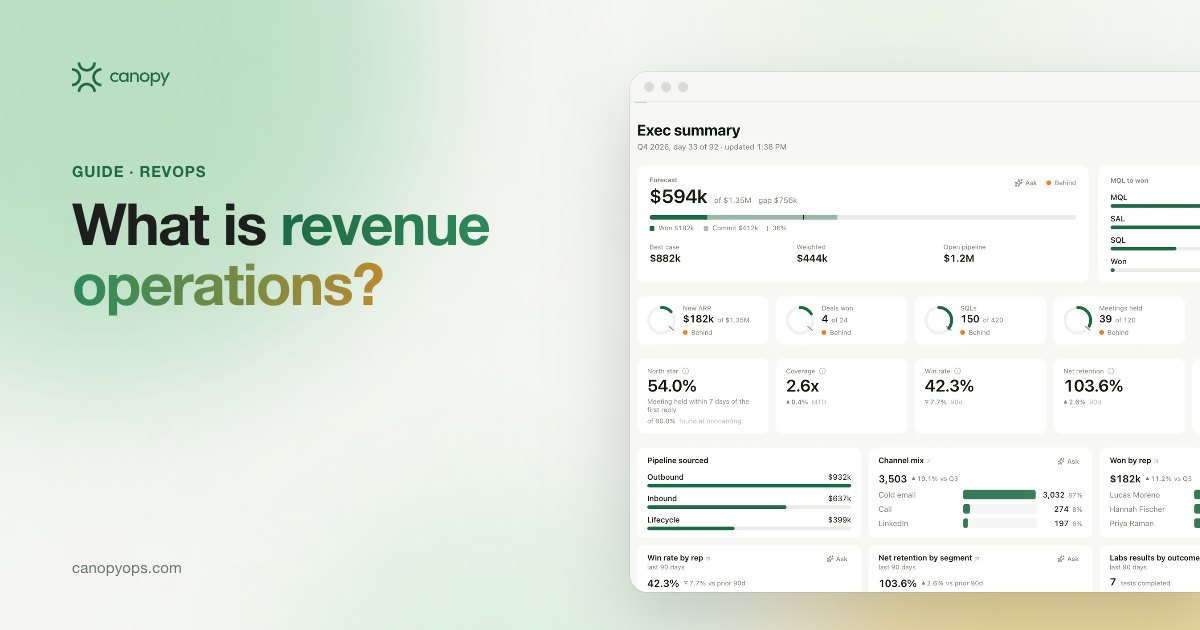
Revenue operations (RevOps) runs the shared systems behind sales, marketing and customer success: the CRM, the data, the handoffs between teams and the reporting everyone plans from. When AI agents take on execution work such as first touches and follow-up, RevOps also sets what those agents may do and measures them against revenue.
Key takeaways on revenue operations and AI agents
- Revenue operations owns the CRM, the data model, the process between teams and the revenue reporting, so marketing, sales and customer success plan from one set of numbers.
- RevOps covers the whole customer lifecycle, while sales operations supports the sales team.
- Once AI agents do execution work, the RevOps team sets send permissions, keeps CRM data clean enough for agents to act on, reports results by source (agent-sourced pipeline included) and runs message changes as weekly tests.
- A team adding agents should record its baseline KPIs before the first send, because a system that never measured its starting point cannot show what changed.
What does revenue operations do?
Revenue operations keeps the revenue engine running as one system. A RevOps team decides how a lead moves from form fill to closed deal to renewal, which CRM fields each stage needs, who owns the record at every handoff and which numbers leadership reviews each week. The work is specific and mostly invisible when it goes well: routing rules, stage definitions, lifecycle stages, deduplication, forecast roll-ups, tool contracts and the integrations that keep the stack talking.
Most revenue operations work sits between departments. Marketing generates the lead, sales works it, customer success keeps the account, and each team bought software for its own job. Revenue operations owns the gaps between them, which is where leads stall and renewals surprise people. A company without anyone in that seat usually ends up with several versions of pipeline and a Monday meeting spent arguing about which one is right.
How HubSpot, Forrester and Gartner describe revenue operations
The best-known definitions of revenue operations agree on alignment and differ on scope. HubSpot's guide to revenue operations strategy (updated July 2026) describes RevOps as the function that aligns sales, marketing and customer success around shared data, processes and goals, aiming for predictable, scalable revenue growth. Forrester senior analyst Jerry Zhao, in an August 2024 Forrester blog post, calls it "a highly configured, iterative commercial execution strategy" that unifies data, processes, technology and talent across the customer lifecycle. Forrester treats it as a strategy that can sit inside different org structures.
Gartner put a number on adoption. In a May 2021 Gartner prediction, the firm said 75% of the highest-growth companies in the world would deploy a RevOps model by 2025. The target year has passed and we found no Gartner follow-up measuring it, so read it as a 2021 forecast of where the market was heading.
The four pillars of a RevOps framework
HubSpot's RevOps framework names four pillars: operations, enablement, insights, and tools and technology. The list works as a checklist for what the function should own. In practice, operations means process, such as routing, stage exit criteria, handoffs and forecasting. Enablement means the training, playbooks and content that help reps and CSMs do the job. Insights is reporting and analysis, the numbers leadership plans from. Tools and technology covers the stack, from the CRM to its integrations, access and contracts. A RevOps team that owns only insights tends to become a reporting desk, and one that owns only tools tends to become CRM admin.
What a revenue operations team owns, area by area
Revenue operations typically owns the six areas in the table below, and each one changes shape once agents start drafting, sending and updating records inside the CRM. The right-hand column describes the same area after agents take on execution work.
| Area | What RevOps owns today | What changes when agents do the execution |
|---|---|---|
| CRM and data model | Objects, fields, lifecycle stages, deduplication | Agents read and write the same records, so a missing field stops a send instead of skewing a chart |
| Lead routing and handoffs | Assignment rules, MQL to SQL criteria, speed to lead | An agent can research a lead and draft the first touch minutes after a form fill; RevOps decides which leads qualify and who approves |
| Process and stage definitions | Deal stages, exit criteria, next-step rules | Agents draft the next step after each call, and stage rules decide when a draft is due |
| Automation | Workflows, sequences, enrichment | Workflows trigger agents, and RevOps sets each team's send mode: Draft only, Approve to send or Automatic |
| Reporting and forecasting | Dashboards, pipeline reviews, the forecast roll-up | Pipeline is reported by source, including agent-sourced, with every agent action attributed in the CRM |
| Tool stack | Contracts, integrations, user access | Fewer point tools, and one agent layer on the CRM with scoped access and an audit log |
Why the CRM data model matters more once agents act on it
The CRM data model is where agent work exposes problems fastest. A dashboard can average over a few hundred contacts with no lifecycle stage and still draw a chart. An agent told to follow up with every lead that has no deal yet will either skip those contacts or write to the wrong ones. Salesforce's 2026 State of Sales report, a survey of 4,050 sales professionals, found that 51% of sales leaders using AI say disconnected systems are slowing their AI initiatives, and that 74% of sales professionals are focusing on data cleansing. Salesforce sells AI agents, so these are vendor survey figures. For a RevOps team, data quality now decides whether execution happens at all, and accurate reporting follows from it.
Revenue operations vs sales operations: what each team owns
Sales operations supports the sales team. Revenue operations supports every team that touches revenue. Sales ops usually owns territories, quotas, compensation plans, the sales forecast and the parts of the CRM that reps use. RevOps applies the same disciplines across marketing and customer success, so the lead definition marketing reports on is the one sales accepts, and the renewal date customer success works from matches the one finance books. Many companies run both, with sales ops as a team inside RevOps focused on the sales motion. The gap shows up in the numbers: a strong sales ops team can make the sales forecast accurate while marketing and customer success still keep separate definitions of a qualified lead or an at-risk account.
| Question | Sales operations | Revenue operations |
|---|---|---|
| Who it supports | The sales team | Marketing, sales and customer success |
| Usual reporting line | Head of sales | Whoever owns the full revenue number, often a CRO, COO or CEO |
| What it owns | Territories, quotas, compensation, the sales forecast | Lifecycle stages, handoffs, the full-funnel data model, revenue reporting |
| Metrics it watches | Quota attainment, win rate, sales cycle length | Pipeline by source, stage conversion, net revenue retention |
| Role once agents arrive | Configures rep tools and sales workflows | Sets what agents may do across every team and reports their results |
Why companies build a revenue operations function
Companies build revenue operations when the gaps between teams start costing revenue nobody can trace. The usual triggers are a forecast nobody trusts, a lead that waited days for a first touch, a renewal that caught customer success off guard, or a tool bill that kept growing while usage fell. Each of those failures happens between tools and teams, where no single department owns the outcome.
Sales leaders feel the loss of control. Gartner surveyed 210 chief sales officers and senior sales leaders in January and February 2026, and in its July 2026 Gartner press release on AI agents and sellers reported that 60% of CSOs said their revenue number is largely shaped by factors they cannot control. A revenue operations function shrinks that list. Lead routing, follow-up timing, data quality and stage discipline are all controllable, and RevOps makes each of them visible and owned.
What changes in revenue operations when AI agents do the execution work
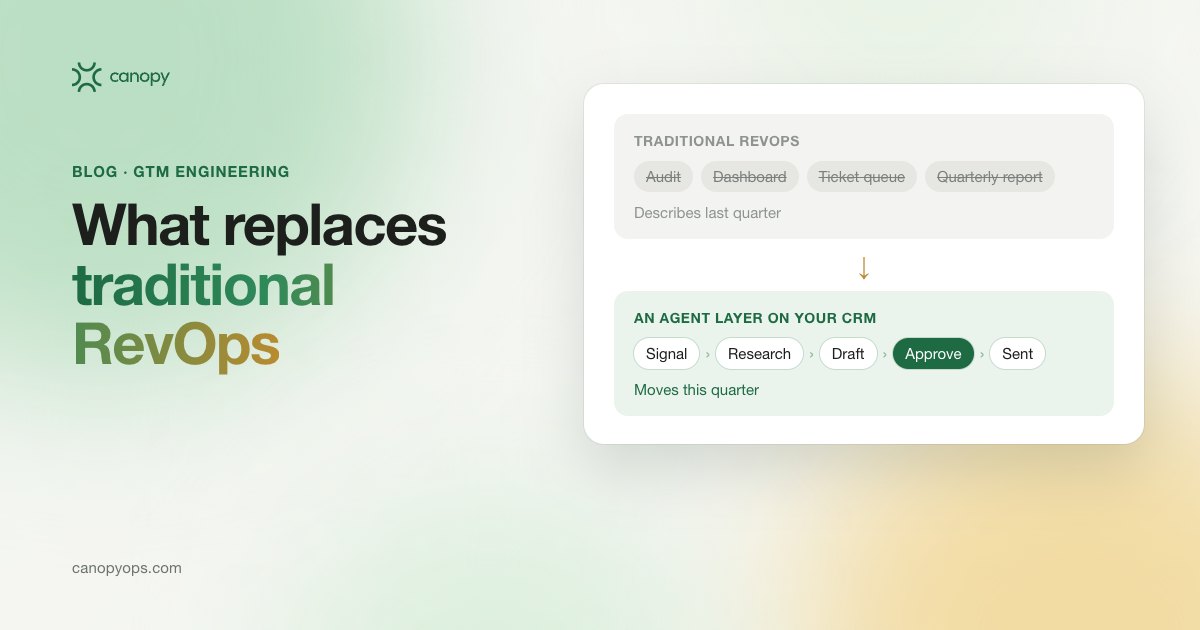
AI agents move revenue operations from designing the work to supervising it. In the traditional setup, RevOps builds the system and people execute inside it: SDRs research accounts, reps write follow-up from memory, CSMs notice a usage drop when they happen to look. Agents can now do much of that execution inside the CRM. Gartner's July 2026 release predicts AI agents will outnumber sellers 10 to 1 by 2028, yet fewer than 40% of sellers will say agents improved their productivity. Closing that gap takes supervision, and supervision lands on RevOps as four new jobs. I've made the opinion case against audit-and-dashboard RevOps in Traditional RevOps is dead.
Setting what agents are allowed to send
Send permissions are the first new RevOps responsibility. Someone has to decide, per team, whether an agent may only draft, must wait for a person to approve each message, or may send on its own. In Canopy those levels are Draft only, Approve to send and Automatic, set per workspace in Canopy's agent control settings, with every approval and send logged against the person who made it. The defaults follow the risk. Deal follow-up is locked to Approve to send, because the rep owns every word on an open opportunity. Customer messages start as Draft only, so the CSM decides whether and when anything goes out. Every send is approved until the client chooses otherwise. RevOps is the natural owner of these rules, since it already owns permissions, field access and the automation inventory.
Keeping CRM data clean enough for agents to act on
Data hygiene stops being a quarterly project once agents read the CRM to decide what to do. An agent choosing which closed-lost deals to re-engage relies on the loss reason, the close date and the last contact. A blank field means a skipped deal or a badly aimed email. RevOps teams running agents move from periodic cleanups to continuous checks, where missing next steps and stages are found daily and fixed with the record owner's approval. The fix has to land in the CRM itself. HubSpot or Salesforce stays the source of truth, and the agent layer should write every action back to the record so the next agent, and the next rep, sees the full history.
Measuring agents on revenue, by source
Agent output belongs in the same CRM reports as human output, attributed by source. RevOps already owns pipeline-by-source reporting, and agents add one more source to it. Outbound agents should be measured on reply rate, positive reply rate, meetings booked and pipeline. Open rate stays off the outbound scorecard. Lifecycle email, which goes to people who already know the company, can add open rate, click rate and click-to-open rate alongside meetings and pipeline. Retention work is measured on net revenue retention. SaaS Capital's 2025 B2B SaaS retention benchmarks, drawn from more than 1,000 private B2B SaaS companies, put median net revenue retention at 101% and median gross revenue retention at 91%. Those medians give a RevOps team an outside reference next to its own baseline.
Running message changes as a weekly test
Agents make it cheap to change a message, so RevOps change management turns into an experiment loop. The working pattern is to test each new message version against a holdout that keeps the current one, score both on the KPI the team chose and promote the winner. In Canopy the Learnings workspace runs that loop every week, proposes the winning version with its evidence, and applies it when a person accepts it with one click. New claims, offers and pricing always wait for a person. RevOps owns the guardrails: which KPIs count, who accepts a change, and what gets rolled back when a variant loses. Annual planning still sets direction. Weekly tests settle the wording.
A revenue operations strategy for teams adding AI agents
A workable revenue operations strategy for agents starts with numbers and a single leak, and expands only after the first workspace produces results. The sequence below is the one I'd follow at any B2B company with a working CRM, whoever builds the agents.
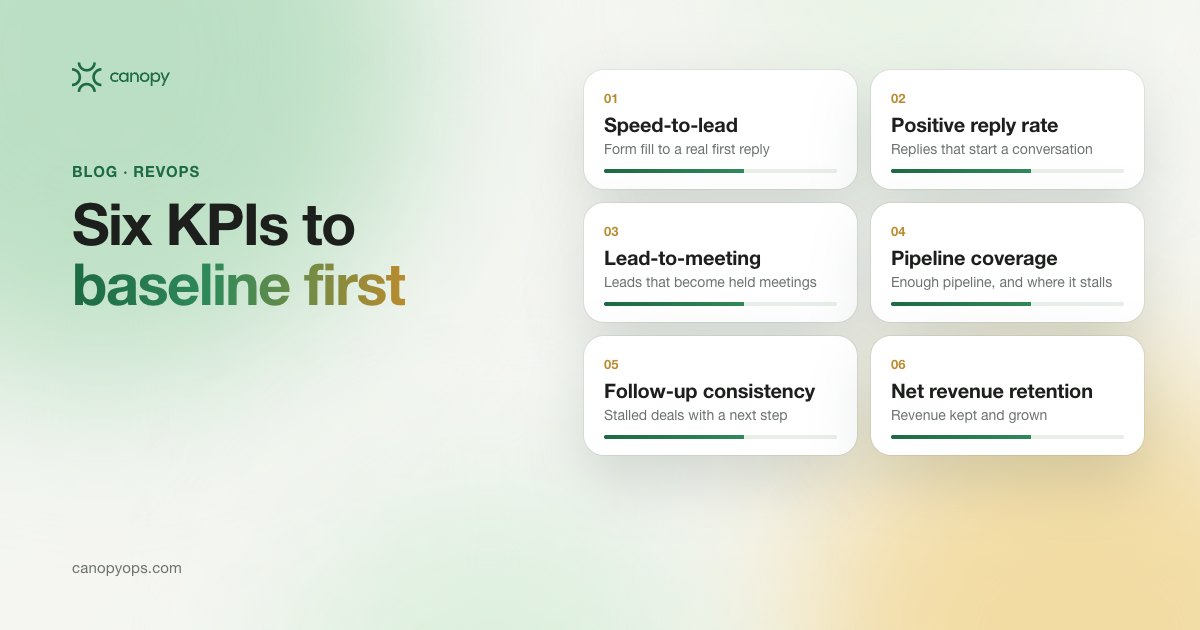
- Baseline the KPIs before anything ships. Record speed to lead, reply and meeting rates, stage conversion and retention as they stand today, using the six KPIs to baseline before buying another GTM tool as the list.
- Map the revenue process end to end with the people who run it, and mark where leads, deals and renewals stall. Canopy runs this step as a revenue workshop in week 0.
- Point one workspace at the biggest leak: outbound if pipeline is thin, lifecycle if leads with no deal pile up, deal follow-up if opportunities go quiet after the first call, or customer success if renewals keep surprising the team.
- Fix the fields that workspace depends on before agents use them.
- Start every send on approval and review drafts daily with the team that owns them.
- Hold a weekly review against the baseline, and switch on automatic sending only where the results earn it.
- Add the next workspace once the first is producing.
Canopy's deployment model runs in that order: a revenue workshop in week 0, a 30-day build of the first workspace, a 90-day adoption period with GTM Engineers in the weekly review, monthly sprints, and quarterly waves into the next workspace. Canopy's workspaces each target one of the leaks named above, from signal-based outbound and behavior-triggered lifecycle email to deal follow-up drafted from call notes and churn and renewal signals for customer success.
Who should own the agent layer in revenue operations?
The agent layer can be owned in four ways, and each one puts accountability somewhere different. An in-house RevOps or GTM engineering team can build agents itself, which takes engineers who can maintain the data, the workflows and the models after launch. A RevOps team can also buy agent software and configure it alone. Project-based outside help can set up the same tools and leave. Or a vendor can build and run the system on the company's CRM, with GTM Engineers who answer for the numbers.
Ownership after handover is the first question to settle about any agent layer. Gartner predicted in a September 2026 press release on forward-deployed engineering that by 2028, 70% of enterprises will abandon agentic AI built through vendor forward-deployed engineering, trapped by soaring costs and unable to evolve it on their own. Gartner said success should be judged by whether the enterprise can manage, optimize and scale the technology after handover. In a June 2025 release, Gartner also predicted that over 40% of agentic AI projects will be canceled by the end of 2027, citing escalating costs, unclear business value or inadequate risk controls.
Canopy's agentic revenue system is built and run for the client, so the handover question applies to us as well. Each client gets a private instance on top of its own HubSpot or Salesforce, and the CRM stays the source of truth. Every send, reply, booked meeting and lifecycle stage change is written back to the CRM. Every agent action, including who approved each send, can be downloaded as CSV. Send modes are set per workspace in Agent control, and every change is logged with who made it and when. The revenue operations software page shows what RevOps leaders control day to day, and the integrations page lists the tools Canopy works with.
Common questions about revenue operations
What does revenue operations mean in plain terms?
Revenue operations means running the systems that marketing, sales and customer success share: the CRM, the data, the handoffs and the revenue reporting. The goal is one set of numbers and one process from first touch to renewal. When AI agents take on execution work such as first touches and follow-up, revenue operations also decides what those agents may do and measures their results against revenue.
What does a revenue operations team do day to day?
A revenue operations team maintains the CRM, fixes data problems, manages lead routing and handoffs, keeps stage definitions consistent, runs pipeline and forecast reporting, and manages the tool stack. A typical day might mean changing an assignment rule or cleaning up deals with no next step. With agents in place, the team also reviews send permissions and agent results.
What is the difference between RevOps and sales ops?
Sales ops supports the sales team, while RevOps supports marketing, sales and customer success together. Sales operations usually owns territories, quotas, compensation and the sales forecast. Revenue operations owns the shared lifecycle stages, the handoffs between teams and the reporting that spans the whole funnel. Many companies keep a sales ops team inside a wider RevOps function.
When should a company hire its first RevOps person?
A company should hire its first RevOps person once more than one team works in the CRM and the teams start disagreeing about the numbers. Common signs are leads waiting days for a first touch, conflicting pipeline reports, and tools bought by separate teams that do not share data. Before that point, a founder or sales leader can usually hold the role alongside other work.
What is a RevOps framework?
A RevOps framework is a structure for deciding what the revenue operations function owns and how it works. HubSpot's version uses four pillars: operations, enablement, insights, and tools and technology. A framework for teams running AI agents adds send permissions, continuous data quality checks, reporting by source and a weekly test loop for message changes.
Do AI agents make a revenue operations team unnecessary?
No. AI agents take on execution work such as research, first touches, follow-up drafts and renewal alerts, and that work needs more supervision from revenue operations. Someone has to set what agents may send, keep the CRM data accurate, measure results by source and decide which changes ship. People approve the work and stay accountable for the numbers.
What should RevOps measure when agents send messages?
RevOps should measure agent-sent outbound on reply rate, positive reply rate, meetings booked and pipeline, and leave open rate off that scorecard. Lifecycle email can add open rate, click rate and click-to-open rate. Customer work is measured on net revenue retention and gross revenue retention. Every agent action should be attributed in the CRM so results can be reported by source.
Is RevOps the same as GTM engineering?
RevOps is a function and GTM engineering is a practice, and the two overlap. Revenue operations is the function that owns the revenue system, its data and its reporting. GTM engineering is the hands-on practice of building revenue automation: the data, the workflows and the AI that run parts of the revenue process. Many RevOps teams now hire GTM engineers to build the automation the function owns.
Do we need to change CRMs to run AI agents?
You don't need to change CRMs to run AI agents if the agent layer works on top of the CRM you already have. In Canopy, HubSpot or Salesforce stays the source of truth. Agents read from it, write every send, reply, booked meeting and lifecycle stage change back to the record, and work inside a private instance for each client, so the history stays where your team already works.
How long does it take to add an agent layer to a RevOps stack?
Canopy's deployment takes 30 days to build the first workspace, followed by a 90-day adoption period in which GTM Engineers join the weekly review. The build starts with a revenue workshop in week 0, where the team maps the revenue process and records baseline KPIs. Further workspaces go live in quarterly waves once the first one is producing.
Written by John Miraglia, Co-Founder of Canopy, who leads product and platform. John built and exited a B2B SaaS company by automating every step of the pipeline instead of hiring more reps. Last updated: November 2026.
If you run revenue operations and want agents doing execution work on the CRM you already own, with your team approving what goes out, apply to become a launch partner.
RevOps and leadership
See how Canopy puts this to work on top of HubSpot or Salesforce, with your team approving what sends.