An AI SDR is software that does the prospecting work of a sales development rep: it finds accounts, researches them, drafts first touches and follow-ups, sorts replies and books meetings. 11x, Artisan, Salesforce and HubSpot sell versions. An AI SDR works best when a person approves each send and the team judges it on positive replies, meetings and pipeline.
Key takeaways on AI SDRs
- An AI SDR automates the research and drafting that fill most of an SDR's day, and the setups that hold up keep a person approving every send until results earn the agent more freedom.
- AI SDR products sit in three camps: standalone vendors, agents built into the CRM, and agent layers that GTM Engineers run on the CRM you already own.
- Judge an AI SDR on reply rate, positive reply rate, meetings held and pipeline created, never on open rate.
- Ask any AI SDR vendor to show the agent working on your own accounts before you sign.
What does an AI SDR do?
An AI SDR (AI sales development representative) is an AI sales agent that takes on the work a human SDR does before a first meeting. In outbound, the AI SDR builds a target list from buying signals and your ideal customer profile, researches each account and contact, writes a personal first touch, sends follow-ups and sorts the replies. In inbound, it answers website visitors and new form fills, qualifies them and offers a calendar slot. Most products cover part of that chain. Few cover all of it well.
Research and drafting carry most of the value, because they eat most of a rep's time. The Bridge Group's 2025 SDR Metrics report (351 B2B companies) found the median SDR logs 112 activities a day and gets 4.1 quality conversations out of them. In Salesforce's 2026 State of Sales survey of 4,050 sales professionals, 48% said they lack the bandwidth for adequate cold outreach. An AI SDR agent is a bet that software can do the prep at volume while reps spend their hours in conversations, the split our guide to AI in sales applies across the whole revenue cycle.
Inbound AI SDRs vs outbound AI SDRs
Salesforce draws the inbound and outbound line plainly. Its demand generation page (2026) positions Piper, from Qualified, as its AI SDR for inbound buyers on the website and in the inbox, and Agentforce SDR as an agent for outbound outreach. An inbound AI SDR responds to someone who already raised a hand, so speed matters most and the downside is small. An outbound AI SDR writes to people who never asked to hear from you, and a careless message can cost you the account. Most of this guide covers outbound, where good and bad AI SDRs differ the most.
Which AI SDR platforms exist, and how do they differ?
AI SDR platforms in November 2026 fall into three approaches, and the difference that matters most is who reviews what the agent sends. Vendor details come from each company's own pages and are not a ranking.
| Approach | Examples (November 2026) | Where the agent works | Who reviews sends |
|---|---|---|---|
| Standalone AI SDR | 11x (Alice, Julian), Artisan (Ava) | The vendor's own platform, with its own data and sending | Check each product before buying |
| CRM-native agent | HubSpot Prospecting Agent, Salesforce Agentforce Engagement and Piper | Inside HubSpot or Salesforce | HubSpot: rep review, or send without review. Agentforce Engagement: sends on its own, review optional |
| Agent layer run by GTM Engineers | Canopy | On top of the HubSpot or Salesforce instance you own | A rep approves every message until the team chooses otherwise |
Standalone AI SDR vendors: 11x and Artisan
11x markets "revenue agents" on its homepage (2026): Alice researches accounts and writes email and social outreach for plays such as nurture, reactivation and closed-lost, and Julian is a voice agent for inbound demand. Artisan sells Ava, an AI BDR that finds and enriches leads, writes and sends outreach, handles replies and books meetings, with data, sequencing, deliverability and a dialer in one platform. Neither publishes prices on its homepage. A standalone AI SDR is quick to start. The trade-off is that targeting, copy and sending live in another platform next to your CRM, and your team still has to tune it.
CRM-native AI SDR agents: HubSpot and Salesforce
HubSpot's Prospecting Agent researches target accounts, watches buying signals, finds buying-committee contacts and drafts outreach in each rep's voice for email, phone and LinkedIn. Reps can review and edit drafts or let the agent send without review. HubSpot lists it at $1 per recommended lead as of November 2026, paid in HubSpot Credits. Salesforce's Agentforce Engagement (renamed from Agentforce SDR) emails new or updated leads, answers questions and hands qualified leads to reps. It runs on its own by default, with manual review as an optional setting. Salesforce completed its acquisition of Qualified on 1 April 2026. A CRM-native agent keeps the data where it already lives.
An agent layer run by GTM Engineers: how Canopy runs AI SDR work
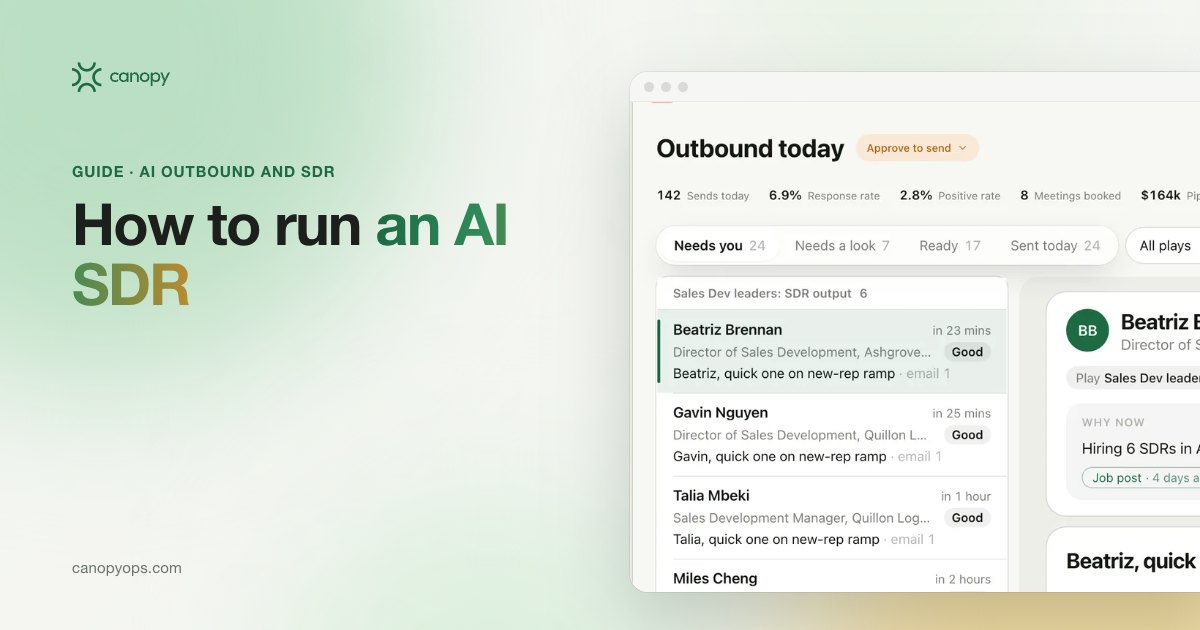
Canopy builds an agent layer on top of the HubSpot or Salesforce instance a team already owns, in a private instance per client, and a pod of GTM Engineers runs it with the client's team. In the Outbound workspace of our AI SDR software, agents find accounts from buying signals, research each one with cited facts, write the first touch and follow-ups, and classify replies, working from verified contact data. The default send mode is Approve to send, and every send, reply, booked meeting and lifecycle stage change is written back to the CRM. Ask any vendor what stays with you if you leave. In our model, the history sits in the CRM you own.
Where do AI SDRs fall short?
AI SDRs fall short in four predictable places: claims nobody can check, volume that outruns judgment, productivity gains sellers don't feel, and CRM data the agent can't see. Each one changes how you should set the program up.
Agent washing and AI SDR claims you can't verify
Gartner warned about "agent washing", chatbots and assistants rebranded as agents, in a June 2025 press release. It estimated only about 130 of the thousands of agentic AI vendors are real, and predicted over 40% of agentic AI projects will be canceled by the end of 2027. Customer claims need the same scrutiny: ask for references you can call, and test any vendor on your own accounts.
Why AI SDR volume burns domains and markets
Most AI outbound goes wrong on volume. Cold email earns replies from a small minority of recipients, so most of what an untuned agent sends earns nothing, and each unwanted message spends sending reputation and goodwill in a market you'll want later. We keep daily volumes sensible, check every address before sending, and never send cold outbound from a client's primary domain. Every list is screened against the CRM and exclusion lists first.
Why sellers don't feel the AI SDR productivity gain
Gartner's July 2026 release predicts AI agents will outnumber sellers 10 to 1 by 2028, yet fewer than 40% of sellers will say agents improved their productivity. Expectations run higher: in Salesforce's 2026 survey, sellers expected fully deployed agents to cut prospect research time by 34% and email drafting time by 36%. The gap usually comes from where the agent sits. If reps open another tool, rewrite weak drafts and chase replies across inboxes, the agent adds work. An AI SDR saves time when drafts arrive with research attached and positive replies reach the account owner straight away.
What happens when an AI SDR can't see the CRM
An AI SDR that can't read the CRM will email current customers, contacts in open deals and people a rep spoke to last week. Salesforce's 2026 survey found 51% of sales leaders with AI say disconnected systems are slowing their AI initiatives. The fix is unglamorous: screen every list against the CRM before it sends, and write every touch back to the right contact so the next rep sees the history.
What should an AI SDR handle, and what stays with a person?
An AI SDR should take the repeatable prep, and people should keep the judgment calls and the accountability. This split is how we run Canopy for sales development teams, and it holds whichever product you choose.
| Task | Hand to the AI SDR | Keep with a person |
|---|---|---|
| Target list | Find accounts with buying signals, screened against the CRM | Define the ICP, signals and exclusion rules |
| Research | Gather company, person and timing facts, each cited | Spot-check during approval |
| First touch and follow-ups | Draft per account in the team's voice | Approve, edit or reject each draft |
| Replies | Classify as positive, objection, out of office, not now or unsubscribe | Answer positive replies and objections personally |
| Meetings | Route positive replies to the account owner with context | Run the meeting and own the opportunity |
| Testing | Test new variants against a holdout | Accept each winning version; approve any new claim, offer or price |
Approval of each send is the control that matters most in an AI SDR program. Canopy has three send modes, Draft only, Approve to send and Automatic, and every send is approved until the client chooses otherwise. On Approve to send, a rep reviews the morning's drafts with the evidence beside each one, edits what needs editing and approves the rest. In our agent control settings, send modes are set per workspace and every change is logged with who made it and when. Message changes wait for a person to accept them.
How do you measure an AI SDR?
An AI SDR should be measured on four numbers: reply rate, positive reply rate, meetings held and pipeline created. Baseline them before launch, as covered in the KPIs to baseline before buying another GTM tool, because the few outside benchmarks mostly come from vendors measuring their own platforms.
| KPI | How to calculate it | Outside anchor |
|---|---|---|
| Reply rate | Replies of any kind divided by emails sent | Your own baseline from before launch |
| Positive reply rate | Replies that want to talk divided by emails sent | No reliable public benchmark; use your own baseline |
| Meetings held | Meetings that took place, sourced by the agent, per month | Bridge Group 2025: median human SDR quota of 10 held meetings a month |
| Pipeline created | Value of opportunities sourced by the agent's outreach | Your own trailing baseline |
Why open rate is the wrong AI SDR metric
Open rate tells you an email was loaded, which says little about whether the buyer wants a conversation. Tuning an AI SDR toward opens rewards curiosity-bait subject lines, and buyers notice. Canopy measures Outbound on reply rate, positive reply rate, meetings booked and pipeline, and never optimizes it for opens. Lifecycle email goes to contacts who already know you, so open rate, click rate and click-to-open rate are useful signals there.
How long to give an AI SDR before you judge it
Give an AI SDR at least as long as a new human rep: the Bridge Group's 2025 report puts average SDR ramp at 3.0 months. Sequences also need to finish before you read them, so wait until the last follow-up in each sequence has gone out. Canopy's deployment model follows that timing: a 30-day build, then a 90-day adoption period with GTM Engineers in the weekly review.
How to run an AI SDR program week to week
What to set up before an AI SDR sends anything
- Write down the ideal customer profile and the signals that put an account on this week's list, such as hiring, funding or stack changes.
- Load exclusion lists for customers, open opportunities, partners and anyone a rep wants kept out.
- Set up dedicated sending domains and warmed mailboxes, and verify every list.
- Give the agent a research brief and examples of your best reps' messages.
- Start on approval.
What happens in the weekly AI SDR review
The weekly AI SDR review reads replies, meetings and objections, then decides what changes next week. GTM Engineers bring the four KPIs plus deliverability, and the team reads a sample of replies in the buyers' own words. Canopy's Learnings workspace tests new message versions against a holdout, measures them on the client's KPIs and proposes the winning version each week with its evidence for a person to apply in one click. A new claim, offer or price still waits for a person.
When to let an AI SDR send without approval
An AI SDR should move to automatic sending only when the evidence says drafts no longer need a person. I look for two signs held over several weeks: reps approving most drafts without edits, and a positive reply rate that holds or climbs. Even then, new claims, offers and pricing stay behind approval. Make the call per campaign, on your own numbers, and keep the option to switch back.
Common questions about AI SDRs
What is an AI SDR, in plain terms?
An AI SDR is an AI agent that handles a sales development rep's prospecting work: finding and researching accounts, writing first touches and follow-ups, sorting replies and booking meetings. 11x, Artisan, HubSpot and Salesforce all sell versions. The setups that work keep a person approving what goes out and measure the agent on positive replies, meetings and pipeline.
Will an AI SDR take over my SDRs' jobs?
An AI SDR keeps your SDRs but changes their day. In the programs we run, agents take research and drafting, and SDRs approve drafts, answer replies and run meetings. Gartner predicts agents will outnumber sellers 10 to 1 by 2028, yet fewer than 40% of sellers will say agents improved their productivity, so the operating model decides the outcome.
Is an AI SDR the same as an AI BDR?
An AI SDR and an AI BDR are the same kind of agent under two labels. Artisan calls Ava an AI BDR, while Salesforce calls Piper an AI SDR. Some companies split the human roles between inbound and outbound, but the split varies. Judge any product on what it does: inbound response, outbound prospecting or both.
How much does an AI SDR cost?
Most AI SDR vendors don't publish prices. As of November 2026, 11x and Artisan show none on their homepages, and Salesforce says its AI sales agent cost depends on conversations and data integration. HubSpot lists its Prospecting Agent at $1 per recommended lead, paid in HubSpot Credits. Budget separately for data, mailboxes and the time someone spends running the program.
Should an AI SDR send emails without anyone reviewing them?
An AI SDR should start with a person approving every send. Review catches wrong facts and wrong contacts before a prospect sees them, and the edits show where the agent is weak. HubSpot and Salesforce both offer modes that skip review. Canopy Outbound defaults to Approve to send until the client's own numbers support a change.
What reply rate should an AI SDR get?
An AI SDR should beat your current reply rate. Published reply-rate benchmarks mostly come from sending platforms measuring their own users, so the most reliable anchor is your team's own baseline from before launch. Positive reply rate matters more and has no reliable public benchmark either, so track both against that baseline.
How long does it take to set up an AI SDR?
A properly set up AI SDR takes a few weeks before its first approved send. In Canopy's 30-day build, week one covers sending, the CRM and the ICP, weeks two and three set the agents' voice rules and test drafts with your best reps, and the approval queue opens to the whole team in week four.
Can an AI SDR handle LinkedIn and phone as well as email?
An AI SDR can draft for more than email, though products differ. HubSpot's Prospecting Agent drafts for email, phone and LinkedIn, and Canopy Outbound coordinates LinkedIn touches alongside email so a prospect sees one conversation. Human SDRs work the same way: the Bridge Group's 2025 data splits the median SDR's 112 daily activities across phone, email, LinkedIn and text.
Written by Jon Farrar, Co-Founder of Canopy, who leads lifecycle and go-to-market and was previously head of marketing for an eight-figure global direct-to-consumer brand. Last updated: November 2026.
Canopy is the agentic revenue system, built by the team behind Sprig and Stability AI. We unify your systems, build an agent layer on top, and make it the master platform for everything in your CRM. Our team runs it with you, and we own the results. To run your outbound that way, apply to become a launch partner.
Outbound
See how Canopy puts this to work on top of HubSpot or Salesforce, with your team approving what sends.