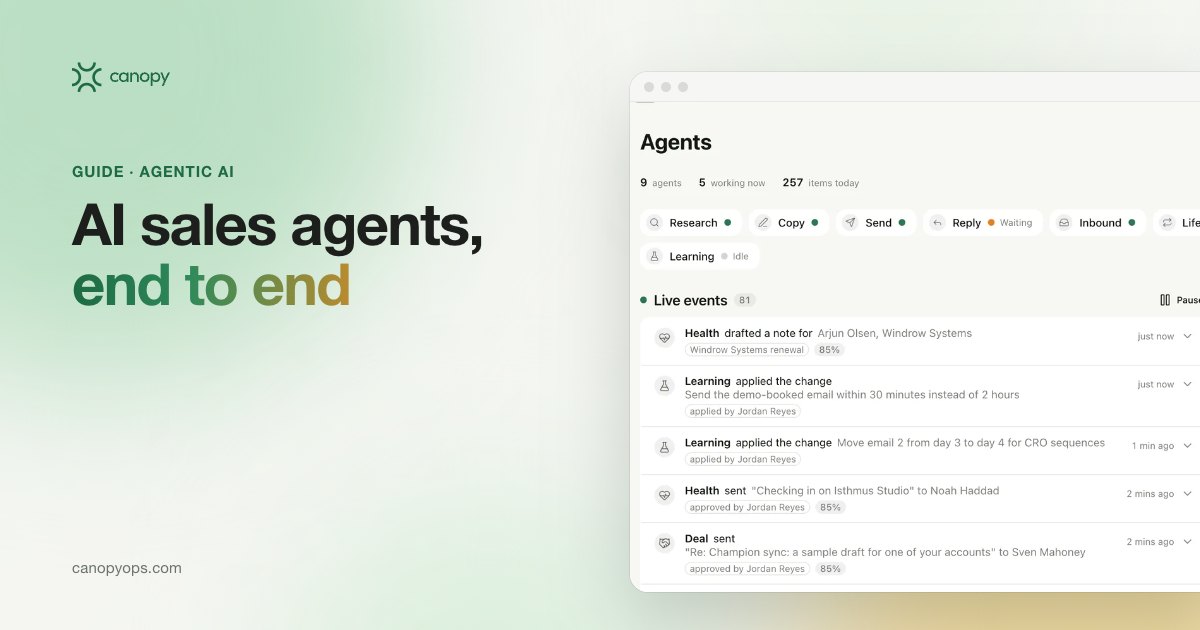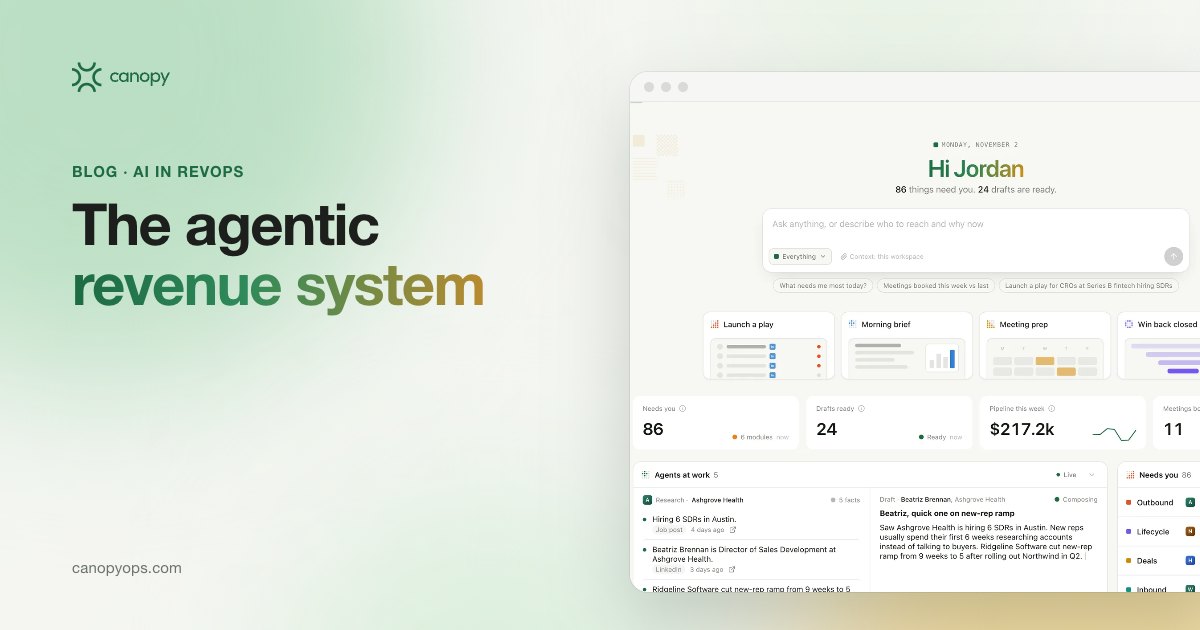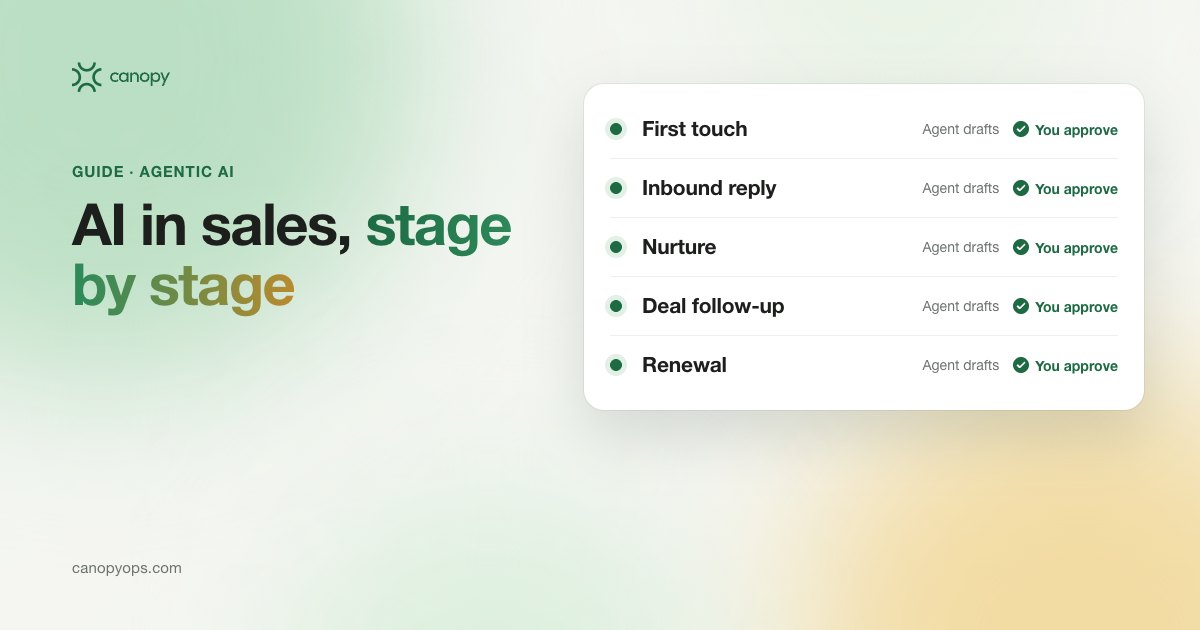
AI in sales moves revenue when agents do defined jobs across the revenue cycle, from the first touch and the inbound reply to nurture, deal follow-up and renewal, inside the CRM the team already runs, with a named person approving what goes out. Most sales teams now use AI. Far fewer can point to a return.
Key takeaways on using AI in sales
- AI in sales pays off when an agent owns one whole job, such as the follow-up after a discovery call, and writes the result back to the CRM.
- The gap between AI adoption and AI return in sales comes from execution, mostly disconnected systems and tools that stop at a suggestion.
- Each stage of the revenue cycle needs its own approval rule, and open deals should stay on Approve to send.
- Every agent should be judged on the KPI for its stage against a baseline recorded before launch.
Is AI in sales paying off yet?
How many sales teams use AI in 2026?
AI is already standard equipment in most sales organizations. Salesforce's State of Sales report (2026), a survey of 4,050 sales professionals, found that 87% of sales organizations use some form of AI and 54% of sellers say they have used AI agents. Salesforce sells its own agents, so read that as a vendor survey. Independent work points the same way: McKinsey's State of AI survey (2026) found respondents most often credit revenue gains from AI to marketing and sales. Among companies with more than $1 billion in revenue, the share scaling AI agents in at least one function rose from 27% to 40%.
Why most companies can't show a return on AI in sales
Return on AI lags far behind adoption. McKinsey's 2026 survey of 1,719 participants found only 37% say AI has contributed positively to EBIT, barely changed from 2025. Gartner predicted in a June 2025 release that over 40% of agentic AI projects will be canceled by the end of 2027, citing escalating costs, unclear business value or inadequate risk controls.
Where the gap between AI adoption and revenue comes from
The gap between AI adoption and revenue sits in execution. In the Salesforce survey, 51% of sales leaders using AI said disconnected systems were slowing their AI initiatives, and the average seller still spends only 40% of their time selling. Gartner's July 2026 prediction says that by 2028 AI agents will outnumber sellers 10 to 1, yet fewer than 40% of sellers will say agents improved their productivity. I think most AI in sales stops at a suggestion. A tool flags the slipping deal or drafts an email nobody sends. Revenue moves when the follow-up actually happens, which takes an agent wired into the CRM and a named person approving its work, the design behind an agentic revenue system.
What is the difference between an AI sales assistant and an AI sales agent?
An AI sales assistant helps a rep with a task. An AI sales agent completes the task and records what it did. An assistant summarizes a call when asked. An agent reads the call notes, drafts the follow-up with the assets the buyer asked for, logs the next step on the deal and queues the email for the rep to approve. The market blurs the two: Gartner's June 2025 release warned about "agent washing", the rebranding of chatbots and assistants as agents, and estimated only about 130 of the thousands of agentic AI vendors are real. A practical test for anything sold as an agent is to name the job it finishes, the system it writes to, and the person who approves its output. We built Canopy's AI sales agent software to pass that test at every stage, on top of HubSpot or Salesforce.
How AI agents work at each stage of the revenue cycle
The revenue cycle has five places where an agent can do real work, and each needs its own job, approval rule and KPI. The table uses the defaults we run in Canopy.
| Stage | What the agent does | Who approves | What to measure |
|---|---|---|---|
| First touch (outbound) | Finds accounts with buying signals, researches each with cited facts, drafts a personal first touch, sorts replies | A rep, on Approve to send | Reply rate, positive reply rate, meetings booked, pipeline |
| Inbound | Scores the lead's fit, checks the CRM for the company, routes it to the right rep, drafts a cited reply in that rep's name within minutes | Approve to send at launch, Automatic once results earn it | Time to first response, meetings, pipeline |
| Nurture (no deal yet, closed lost) | Reads each contact's history and writes the next email inside approved offers and voice rules | Marketing, on Approve to send or Automatic | Open rate, click rate and click-to-open rate, meetings, pipeline |
| Deal | Reads call notes, extracts commitments, objections and next steps, drafts the follow-up | Always the rep: locked to Approve to send | Follow-up speed, stage conversion, win rate, cycle length |
| Renewal and expansion | Brings product usage into the CRM, flags churn risk and expansion, drafts the renewal plan | The CSM, on Draft only by default | Gross and net revenue retention, expansion pipeline |
First touch: how AI agents handle outbound prospecting
Outbound is where most teams first try AI in sales, and where volume does the most damage when quality slips. An outbound agent, often sold as an AI SDR, watches buying signals such as hiring, funding, stack changes and trial sign-ups, researches each account, cites every fact it uses, and writes a first touch to the team's voice rules. The rep's job shifts from researching to approving. Canopy Outbound works from verified contact data, checks every address before sending, and holds every draft for a person by default. Judge it on reply rate, positive reply rate, meetings booked and pipeline, each against the team's own baseline from before launch.
Inbound: how AI speeds up lead response
Inbound leads lose value within minutes, and many companies answer slowly or never. In a 2007 study of InsideSales.com call data, contacting a web lead within 5 minutes produced about 21 times more qualifications than waiting 30 minutes. When RevenueHero submitted demo requests on 1,000 B2B SaaS websites in 2024, 63.5% never responded. An inbound agent scores the lead's fit, checks whether the company is already in the CRM, routes it to the rep who owns the account and drafts a short reply in that rep's name, with every fact cited from the form and the CRM. Our post on agentic inbound and speed to lead covers the routing.
Nurture: how AI runs lifecycle email for leads with no deal yet
Nurture is the stage most CRMs underuse. Contacts who showed interest and never became a deal sit in a fixed sequence that ignores what they did. A lifecycle marketing agent reads each contact's history (opens, clicks, page visits, event attendance and silence) and writes the next message inside the offers and voice rules the marketing team approved. Canopy Lifecycle runs two jobs: turning leads with no deal yet into pipeline, and recovering closed-lost deals. The best public evidence for triggered email comes from ecommerce, where Omnisend's benchmarks (published 2026), covering 470 million automated sends in 2025, found triggered emails beat campaigns on click rate (4.66% against 0.74%) at nearly identical open rates. B2B teams should read those B2C numbers as direction.
Deal: how AI drafts sales follow-up after every call
Open deals are where a missed follow-up costs the most, and where the rep has to stay in charge. A deal agent reads the team's call recordings, pulls out commitments, objections and next steps, and drafts the follow-up with the assets the buyer asked for (see our guide to AI sales follow-up). In Canopy, each call's summary, commitments and next steps sit on the deal beside the drafted follow-up, and one click opens the deal in the CRM to move the stage. Ebsta's 2024 B2B Sales Benchmarks, built on 4.2 million opportunities, found top performers were 412% more likely to have a next step or meeting defined (a relative figure from vendor data). Canopy Deals is locked to Approve to send, so the rep owns every word.
Renewal: how AI helps customer success protect and grow revenue
Renewal risk usually shows up first in product usage, and that data rarely sits in the CRM where the account team works. A customer success agent brings usage onto the account record, combines it with support and relationship signals into a health view, and flags churn risk or expansion to the CSM and AE with the reason attached. It drafts the renewal plan too. Canopy Customers runs on Draft only by default, so the CSM decides whether and when anything reaches a customer. For a benchmark, SaaS Capital's 2025 survey of more than 1,000 private B2B SaaS companies put median net revenue retention at 101% and median gross revenue retention at 91%.
Who should approve what an AI sales agent sends?
The three send modes for AI in sales
Approval rules decide whether AI in sales builds trust with buyers or burns it. Canopy sets one of three send modes per workspace in Agent control. In Draft only, nothing leaves until a person sends it. In Approve to send, each message arrives as a full preview with its evidence and a confidence score, and one click sends it. In Automatic, agents send on their own and flag exceptions to the account owner. Every deployment starts on Approve to send, and Automatic is earned workspace by workspace. Some lines never move: Deals follow-ups always wait for the rep, and new claims, offers or pricing wait for a person.
How vendors set approval defaults for AI sales agents
AI sales agent vendors set different approval defaults, and the default is what most teams end up running. HubSpot's Prospecting Agent lets reps review and edit drafts before they send, or switch to a mode that sends without review. Salesforce's help documentation says Agentforce Engagement works new leads by email on its own, with manual review as an optional setting. In a demo, ask which mode the product ships with and how a bad send gets undone.
How do you measure AI in sales?
Measure every AI sales agent against a baseline taken before it starts, on the KPI for its stage. Teams that skip the baseline end up arguing from anecdotes. Our post on the six KPIs to baseline before buying another GTM tool lists what to record first. A few rules keep the measurement honest:
- Outbound is judged on reply rate, positive reply rate, meetings booked and pipeline.
- Lifecycle adds open rate, click rate and click-to-open rate, and still reports through to meetings and pipeline.
- New message versions run against a holdout group that keeps the current version, so every promoted change has a measured result behind it.
- Retention work is read on gross and net revenue retention over quarters.
In Canopy Learnings, agents test new message versions against a holdout every week, and Learnings proposes the winning version with its evidence for a person to apply in one click. The team's voice rules and offers fix what a draft may say about pricing and proof, and new claims, offers and pricing always wait for a person.
How to start using AI in sales
Start AI in sales with one stage and the biggest leak
Start using AI in sales at the stage of the revenue cycle where revenue leaks most visibly, and get it producing before adding a second. For a team with slow inbound response, that's the inbound first touch. For a team with full calendars and messy deals, it's call follow-up. Connect the agent to the CRM you already own, with HubSpot or Salesforce as the source of truth and the integrations you already pay for. Record the baseline, then launch on Approve to send.
Decide who runs the AI agents after launch
AI agents need an owner after launch, the same way a sales team needs a manager. Someone, often on the revenue operations team, has to clear the approval queue, read the replies, retire messages that stopped working and answer for the numbers. Ask any provider who runs the system in month six and what you keep if you part ways. Canopy's answer: we unify your systems, build an agent layer on top, and make it the master platform for everything in your CRM. Our team runs it with you, and we own the results. The deployment runs a revenue workshop in week 0, a 30-day build, a 90-day adoption period with GTM Engineers in your weekly review, then quarterly waves into the next workspace.
Common questions about AI in sales
How does AI actually help sales teams make more revenue?
AI helps sales teams make more revenue when agents finish specific jobs in the revenue cycle (the first touch, the inbound reply, the nurture email, the deal follow-up and the renewal plan) inside the CRM, with a person approving each send. Tools that only suggest or score leave the work undone, and that is where a lot of AI spending in sales stalls.
What are the best ways to use AI in sales?
The most useful jobs for AI in sales are the ones reps skip when they're busy: researching accounts before a first touch, answering inbound leads within minutes, following up after calls, and preparing renewals from usage data. Start with whichever of those leaks the most revenue today.
Will AI replace salespeople?
No. Agents take over research, drafting, routing and record-keeping, and people keep the relationships and the approvals. Gartner predicts AI agents will outnumber sellers 10 to 1 by 2028, and also that fewer than 40% of sellers will say agents improved their productivity, which says more about how agents get run than about headcount.
Is AI in sales worth the investment?
AI in sales can be worth it, but most companies can't show a return yet. Only 37% of McKinsey's 2026 State of AI respondents said AI had contributed positively to their organization's EBIT. Returns appear when an agent owns a job end to end and is measured against a pre-launch baseline.
What should AI sales agents never do without approval?
AI sales agents should never contact an open opportunity, make new claims, or quote prices or offers without a person signing off. In Canopy, Deals follow-ups are locked to Approve to send, new claims, offers and pricing wait for a person even when a workspace runs on Automatic, and every message change waits for someone to accept it.
How long does it take to deploy AI in a sales team?
A first workspace can be live in about 30 days when the CRM data is usable. Canopy runs a revenue workshop in week 0, a 30-day build with baselines recorded, then a 90-day adoption period with GTM Engineers in the weekly review. Further stages follow in quarterly waves, one workspace at a time.
Do we need clean CRM data before using AI in sales?
You need data good enough for the first job, and the build should fix the gaps it exposes. In Salesforce's 2026 survey, 51% of sales leaders with AI said disconnected systems were slowing their AI initiatives, so connecting systems comes before the first send. Pick a first stage whose data you trust most.
How is AI for B2B sales different from AI for ecommerce?
AI for B2B sales works on accounts and buying committees over long deal cycles, so the CRM record and the approval of each send matter more than raw volume. Ecommerce AI mostly tunes triggered email to individual shoppers. Most published triggered-email benchmarks, including Omnisend's, come from ecommerce, so B2B teams should set targets against their own baseline.
Which KPIs show whether AI in sales is working?
Use the KPI for the stage the agent works. Outbound: reply rate, positive reply rate, meetings and pipeline. Inbound: time to first response. Nurture: click-to-open rate and pipeline. Deals: follow-up speed, stage conversion and win rate. Renewal: gross and net revenue retention. Compare each against a baseline recorded before the agent started.
Should we build our own AI sales agents or buy them?
In my view, most sales teams should buy the agent layer and keep their own people on approvals and strategy. A build makes sense only with engineers who will maintain the data connections, prompts and guardrails long after launch, and few revenue teams have them to spare. Either way, settle who runs the agents after launch before the build starts.
Written by John Miraglia, Co-Founder of Canopy, who leads product and platform. John built and exited a B2B SaaS company by automating every step of the pipeline instead of hiring more reps. Last updated: November 2026.
Canopy is the agentic revenue system: AI agents that work your revenue, from first touch to renewal, built and run for you by the team behind Sprig and Stability AI. Apply to become a launch partner.
Canopy
See how Canopy puts this to work on top of HubSpot or Salesforce, with your team approving what sends.