A sales development representative (SDR) is the salesperson who finds, contacts and qualifies new prospects and books first meetings for account executives, who run the sales process and close. Aaron Ross describes setting up the role at Salesforce.com in 2003, and SDR teams today are measured mainly on held first meetings and the pipeline they create.
Key takeaways on the SDR role
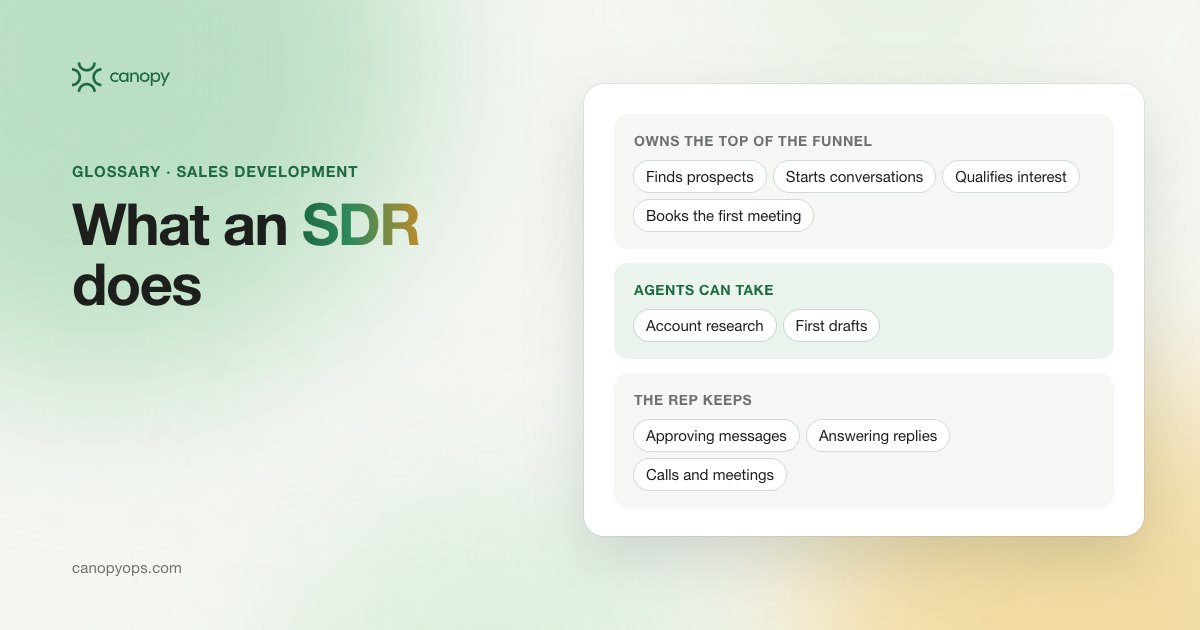
- An SDR owns the top of the funnel: finding prospects, starting conversations, qualifying interest and booking the first meeting an account executive runs.
- Aaron Ross says he started an outbound prospecting group at Salesforce.com in 2003 and split it from inbound reps, closers and account managers.
- SDR and BDR have no standard split, because HubSpot, Salesforce and Ross each draw the line in a different place.
- The Bridge Group's 2025 SDR Models and Metrics report found only 60% of SDRs at quota, the lowest in the study's history, even though the median quota has fallen 40% since 2018 to 10 held first meetings a month.
- AI agents can take account research and first drafts off an SDR's plate, which leaves the rep approving messages, answering replies, making calls and running meetings.
What does a sales development representative do?
A sales development representative works the top of the funnel and hands qualified first meetings to account executives. Salesforce's 2024 definition describes the SDR as the person who manages all top-of-funnel activity in the sales cycle, often sitting between sales and marketing and mixing inbound and outbound work. In Aaron Ross's model the SDR creates and qualifies the opportunity, and the account executive closes it.
Most of an SDR's day goes on outreach. The median SDR logs 112 activities a day, according to The Bridge Group's 2025 SDR Models and Metrics report, a study of 351 B2B companies published in February 2025: 44 phone calls, 41 emails, 19 LinkedIn touches and 8 texts or other. From all of that, the median SDR holds 4.1 quality conversations a day. Phone takes the largest share. Email is 41 of the 112, worth remembering when talk about SDRs turns entirely to AI writing emails.
Where did the SDR role come from?
The SDR title traces back, by Aaron Ross's own account, to Salesforce.com in 2003. In an interview with David Skok on For Entrepreneurs, Ross, co-author of Predictable Revenue, describes starting an outbound prospecting group there and splitting sales into four roles: Market Response Reps for inbound leads, Sales Development Reps for outbound prospecting, Account Executives to close and Account Management. Ross credits the group with "over $100m in incremental recurring revenues". That figure is his own claim, and the interview is titled as an argument for specialized sales teams.
Ross's SDRs were outbound only, and their work ended once a new opportunity was qualified. Salesforce's later definition folds inbound and outbound into one SDR job, which is part of why SDR and BDR mean different things at different companies.
SDR vs BDR: is there a standard split?
No standard split exists between the SDR and BDR titles. HubSpot's glossary describes SDRs as doing outbound prospecting such as cold outreach, and says business development representatives focus on partnership opportunities and market expansion. Salesforce describes the SDR as covering both inbound and outbound presales work. Ross used SDR for the outbound team. Depending on the source, then, an SDR works outbound only, works inbound and outbound, or handles cold outreach while a BDR colleague chases partners.
A shorthand you will see online says SDRs handle inbound and BDRs handle outbound. None of the HubSpot, Salesforce or Ross definitions supports it, and two of them put SDRs on outbound. Titles vary by company, so read the job description: what the role prospects into, who it books meetings for, and what its quota counts.
What metrics are SDR teams measured on?
SDR teams are measured first on held first meetings. Salesforce lists activity counts, qualified prospects added to pipeline and meetings booked as the common SDR measures, and The Bridge Group's 2025 report gives public benchmarks for those and for the team's economics, drawn from 351 B2B companies.
| SDR metric | Bridge Group 2025 figure | Trend the report gives |
|---|---|---|
| Monthly quota | 10 held first meetings (global median) | Down 40% since 2018 |
| Share of SDRs at quota | 60% | Lowest in the study's history |
| Daily activities | 112 (44 phone, 41 email, 19 LinkedIn, 8 text or other) | Median |
| Quality conversations | 4.1 a day | Median |
| Ramp time | 3.0 months (average) | Lowest since 2010 |
| Tenure | 1.9 years (average) | Highest since the early 2010s |
| Annual attrition (2024) | 40% median; promotions were 16% of the breakdown | Not given |
| On-target earnings | $80K median, 68:32 base to variable ($55K base, $25K variable) | Unchanged since 2022 |
| SDR to AE ratio | 1 SDR for every 2.4 AEs | Consistent since 2018 |
What the 2025 Bridge Group numbers say about the SDR job
SDR quotas have come down and fewer reps reach them. The median monthly quota fell 40% since 2018 to 10 held first meetings, yet only 60% of SDRs hit quota in The Bridge Group's 2025 data, the lowest share the study has recorded. Pay has stayed flat at an $80K median on-target figure since 2022. Two numbers point the other way: ramp time is down to 3.0 months, and average tenure is up to 1.9 years. Median attrition in 2024 was 40%, and promotions made up 16% of Bridge Group's attrition breakdown, so part of what looks like churn is SDRs moving up. I read the set as a case against simply asking for more activity, since the median rep already logs 112 touches a day.
How SDR teams are structured and who they report to
The Bridge Group's 2025 data puts one SDR for every 2.4 account executives, a ratio that has held since 2018. Reporting lines vary more: 60% of SDR teams report to sales, 26% to marketing and 10% to a CxO. Whichever leader owns the team, SDR numbers belong in the same pipeline reports as the account executives' numbers, so a held meeting can be traced through to a closed deal. Joining those reports up is a core job of revenue operations, and it settles arguments about what the SDR team actually produced.
How does AI change the sales development representative role?
AI moves the research and writing hours out of the SDR's day. Agents can research an account, find a reason to reach out now and draft a first email before the rep starts work, which leaves the SDR with review, replies, calls and meetings. The Bridge Group's 2025 report listed "AI SDRs" as a distinct category for the first time, at 1% of respondents, so software-run sales development is still rare in the data. Our guide to AI SDRs and how to run one covers the software side. Before adding agents to an SDR team, baseline reply rate, positive reply rate, held meetings and pipeline, using the KPIs to baseline before buying another GTM tool, so you can tell whether anything changed. Open rate won't tell you.
Which parts of SDR work stay with a person?
Judgment and live conversations stay with the SDR. A person decides whether a draft is accurate and right for this buyer, handles an objection on a call, reads a reply that is half interested and picks the next move, and sets up the handoff into the account executive's first meeting. Phone made up 44 of the 112 daily activities in the Bridge Group's 2025 figures, and I'd keep those calls with people. Accountability belongs with the SDR as well: when an email goes out under an SDR's name, the SDR or a manager should have approved it.
SDR, BDR, AE and AI SDR compared
| Term | What the role does | Usually measured on | Where the definition comes from |
|---|---|---|---|
| Sales development representative (SDR) | Prospects, qualifies and books first meetings | Held first meetings, activity, pipeline created | Aaron Ross (Salesforce.com, 2003); Salesforce (2024) |
| Business development representative (BDR) | Varies by company; HubSpot describes partnership and market expansion work | Varies with the job description | HubSpot glossary |
| Market Response Rep | Ross's inbound role, answering incoming leads | Not stated in the source | Aaron Ross |
| Account executive (AE) | Runs the sales process and closes the opportunities SDRs create | Closed deals | Aaron Ross |
| AI SDR | Software agents doing parts of the SDR job, such as research, drafting and reply handling | Reply rate, positive reply rate, meetings, pipeline | The Bridge Group, 2025 (1% of respondents) |
How Canopy supports an SDR team
Canopy is the agentic revenue system, and its Outbound workspace takes research and drafting off an SDR team's plate while every send waits for approval. A rep or leader describes who to reach and why now, picks a segment, persona and sender, and launches a play, or asks in plain English: "Launch a play for CROs at Series B fintech hiring SDRs". Signals such as SDR hiring, a new VP of Sales, funding or pricing-page visits narrow the play to accounts showing them now.
With Canopy, the research and the first draft are done before the SDR logs in. Every fact carries a source and a date, nothing older than 30 days goes into copy, and every address is verified before enrollment. The drafting agent holds any draft with an unsupported sentence for editing. Reps review drafts each morning in Outbound Today and approve in one click, and LinkedIn steps arrive as tasks the rep sends. Collision checks keep two plays off one contact and respect AE-owned accounts. Every deployment starts on Approve to send in Canopy's agent control settings, and the page on Canopy for sales development teams shows how an SDR team's week runs.
What happens to SDR replies and inbound leads in Canopy
Replies arrive sorted into five types, each with a suggested next move. A positive one goes back with the rep's booking link, the meeting lands on the calendar and a deal is created in HubSpot. New form fills get a personal reply in the owner's name within 5 minutes, routed by fit, territory or round robin, which covers the inbound work Ross gave to Market Response Reps. Our post on agentic inbound and speed to lead covers that side. The SDR's day shifts from researching and writing to approving, replying and running meetings.
How SDR managers and revenue leaders track the work
SDR managers in Canopy see replies, positive replies, meetings held, sales-accepted opportunities and pipeline. Canopy measures Outbound on reply rate, positive reply rate, meetings and pipeline, and never on open rate. Send modes are set per workspace, and every change is logged with who made it and when. A pod of GTM Engineers runs the system with the team, with a founder in the weekly review. Revenue leaders who want the same view across teams can see how Canopy works for RevOps and revenue leaders.
Common questions about sales development representatives
What is a sales development representative's job?
A sales development representative finds and contacts new prospects, qualifies their interest and books the first meeting, which an account executive then takes through to a closed deal. Day to day that means research, emails, calls, LinkedIn messages and follow-ups. The median SDR logs 112 activities a day, according to The Bridge Group's 2025 report, and SDR quotas are counted in held first meetings.
What does SDR mean in sales?
In sales, SDR stands for sales development representative, the rep who works the top of the funnel and books first meetings for account executives. Aaron Ross used the title for the outbound prospecting group he says he started at Salesforce.com in 2003. Some companies use BDR, business development representative, for a similar or overlapping job.
Is a BDR the same job as an SDR?
Sometimes, and no standard rule decides it. HubSpot's glossary puts SDRs on outbound prospecting and BDRs on partnerships and market expansion. Salesforce describes SDRs as doing both inbound and outbound work, and Aaron Ross used SDR for outbound only. The popular rule that SDRs handle inbound and BDRs handle outbound has no support in those sources, so read each job description for what the role prospects into and what its quota counts.
How many meetings should an SDR book each month?
The global median SDR quota is 10 held first meetings a month, according to The Bridge Group's 2025 report, down 40% since 2018. Only 60% of SDRs reached quota, the lowest share in the study's history. Bridge Group counts meetings that were held, so a booked meeting that no-shows does not count toward that number.
How much does an SDR make?
Median SDR on-target earnings are $80K a year in The Bridge Group's 2025 report, unchanged since 2022. That is a $55K base and $25K in variable pay, a 68:32 split. The figure is a median across 351 B2B companies, so a particular market or company stage can sit well above or below it.
How long does it take a new SDR to ramp?
Average SDR ramp time is 3.0 months in The Bridge Group's 2025 data, the lowest since 2010. Average tenure is 1.9 years, the highest since the early 2010s. Median annual attrition in 2024 was 40%, and promotions were 16% of Bridge Group's attrition breakdown, so part of SDR turnover is reps moving up.
Should SDRs report to sales or marketing?
Most SDR teams report to sales: 60% in The Bridge Group's 2025 report, against 26% that report to marketing and 10% that report to a CxO. Either line can work if the team's quota, its definition of a qualified meeting and its pipeline reporting are agreed with the account executives who take the handoff.
How many SDRs do you need per account executive?
The Bridge Group's 2025 report puts the ratio at one SDR for every 2.4 account executives, consistent since 2018. Treat it as a starting point. The right number depends on how many first meetings each account executive can run in a month and how many the SDR team can hold against a median quota of 10.
Will AI take over the SDR job?
AI agents now handle parts of the SDR job, mainly account research and first drafts, while fully software-run SDR teams remain rare. The Bridge Group's 2025 report listed AI SDRs as a category for the first time, at 1% of respondents. Calls, judgment on replies and the handoff to an account executive still need a person, and someone should approve what goes out under a rep's name.
How does Canopy work with an SDR team?
Canopy's Outbound workspace finishes account research and first drafts before SDRs log in, with every fact cited and every address verified, and a rep reviews and approves each email. Every deployment starts on Approve to send. Replies arrive sorted with a suggested answer, and a positive one goes back with the rep's booking link while the meeting and the deal land in HubSpot.
Written by Jon Farrar, Co-Founder of Canopy, who leads lifecycle and go-to-market and was previously head of marketing for an eight-figure global direct-to-consumer brand. Last updated: November 2026.
Canopy is the agentic revenue system, built by the team behind Sprig and Stability AI. If you run an SDR team and want research and first drafts done before your reps log in, with a person approving every send, apply to become a launch partner.
RevOps and leadership
See how Canopy puts this to work on top of HubSpot, with your team approving what sends.