A GTM engineer builds and automates the systems a revenue team runs on: CRM workflows, lead routing, data enrichment, outbound sequences and the connections between sales tools. GTM engineering is the function built around that work. The role overlaps with revenue operations (RevOps), which owns process, forecasting and reporting, while the GTM engineer ships the automation itself.
Key takeaways on the GTM engineer role
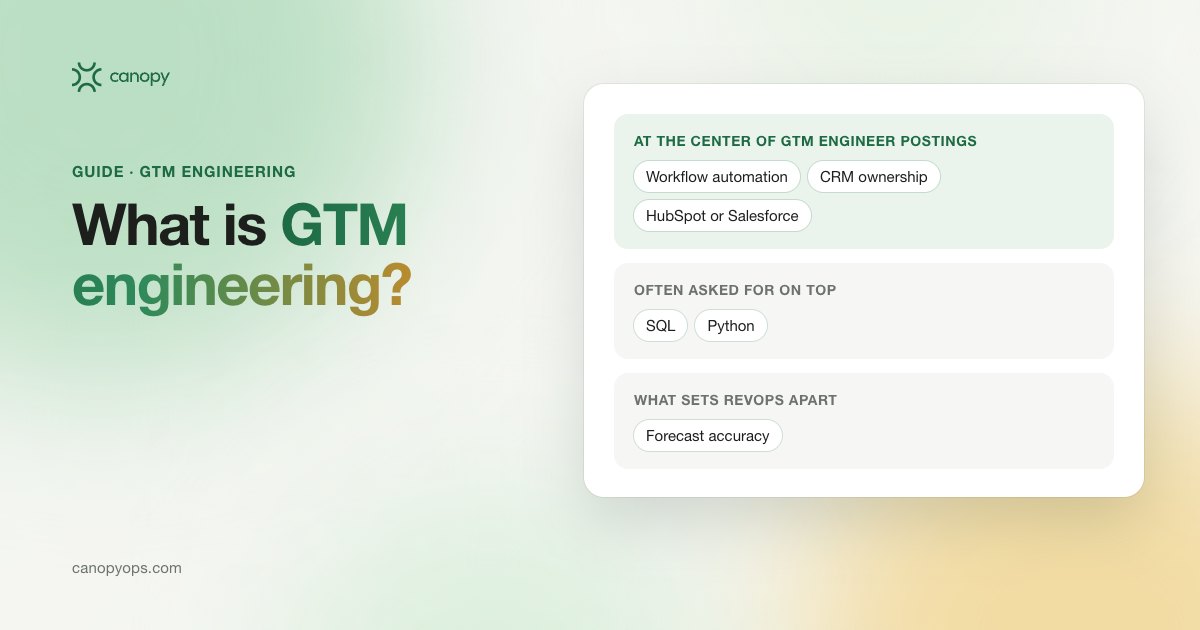
- A GTM engineer builds and maintains a company's go-to-market systems, and job postings put workflow automation and CRM ownership at the center of the role.
- GTM engineering and RevOps share most of their responsibilities in job postings, and forecast accuracy is the duty that sets RevOps apart.
- GTM engineer postings often ask for SQL or Python on top of hands-on CRM experience in HubSpot or Salesforce.
- The GTM engineer title spread between 2023 and 2025 and is still rare next to RevOps, sales ops and SDR roles.
- A company can hire a GTM engineer, grow one from its RevOps team or buy the capability inside a system run by GTM Engineers, which is how Canopy works.
What does a GTM engineer do?
A GTM engineer builds the machinery behind a company's go-to-market motion and keeps it running. In an October 2025 Bloomberry analysis of 1,000 GTM engineering job postings, the most common responsibilities were building and automating GTM workflows, integrating the tools in the GTM tech stack, and owning or optimizing the CRM. Bloomberry sells job-postings data and pulled the postings through its own product, so read the study as Bloomberry's analysis of its own data. In practice, a GTM engineer takes a sales or marketing idea, such as a routing rule, an enrichment step, a lead score or a triggered sequence, turns it into a working system, and fixes it when the data underneath changes.
What GTM engineering means as a function
GTM engineering is the name for that build work once a company gives it an owner. Before the title existed, the same jobs were spread across RevOps, marketing ops, sales ops and whoever was good with spreadsheets. GTM engineering pulls the work into one seat and adds engineering habits: version the logic, test before shipping, watch for breakage and write down what each workflow does. The function serves sales, marketing and customer success at once, which is why it usually reports into RevOps or straight to a revenue leader. A small company may run GTM engineering with one person, and a larger one gives it a team and a backlog of its own.
What a GTM engineer works on day to day
A GTM engineer's week is mostly maintenance and small builds, with a large project every so often. The recurring work, in my experience, looks like this:
- Checking that workflows ran overnight and fixing the ones that failed or wrote bad data to the CRM.
- Building and refreshing account and contact lists against the ideal customer profile.
- Adding a field, a routing rule or a scoring change because sales asked for it on Monday.
- Setting up a new outbound sequence or lead handoff and testing it on a handful of records first.
- Merging duplicates and filling gaps in records so reports and automations can trust them.
- Answering "why did this lead go to the wrong rep?", usually one condition in one workflow.
A GTM engineer's larger projects tend to be CRM migrations, a new tool joining the stack, or rebuilding lead routing after a sales reorganization. Most of the hours go into the unglamorous layer, and that layer decides whether reps trust the CRM at all.
Where did the GTM engineer role come from?
The GTM engineer title is only a few years old. Bloomberry says GTM engineering "didn't exist as a formal role" three years before its October 2025 analysis, and it found hardly any GTM engineering jobs through 2023. Kyle Poyar's Growth Unhinged newsletter, using job-post data from Sumble in September 2025, counted 45 GTM engineer job posts in the previous month and 128 in the previous three months, up from fewer than 10 posts a month in 2024. The title spread quickly from 2023 to 2025, though the build work behind it is much older.
GTM engineer roles are still a small slice of revenue hiring. The same Growth Unhinged post found that from June to August 2025 there was one GTM engineering job post for every 14 RevOps posts, 35 sales ops posts and 92 SDR posts. Given those ratios, a lot of GTM engineering work in 2025 was done by people holding RevOps or sales ops titles.
What skills and tools do GTM engineer job postings ask for?
GTM engineer job postings ask for technical skill on top of go-to-market tool experience. Bloomberry found SQL and Python each appeared in 38% of the GTM engineer postings it analyzed, and the average posting asked for about four years of experience (4.11 years). The coding these roles use is practical: pulling data to check a report, writing a short script to clean a list, or building a step that a no-code workflow can't handle. I'd rather hire a candidate who can read a CRM data model and explain why a workflow fired than one with a longer list of languages.
Which tools appear most often in GTM engineer job postings
The tools named most often in the GTM engineer postings Bloomberry analyzed are CRMs, followed by sales engagement, automation, call recording and reporting tools. The table lists the share of postings that named each tool.
| Tool | What it is | Share of GTM engineer postings naming it |
|---|---|---|
| HubSpot | CRM and marketing automation | 52% |
| Outreach | Sales engagement and sequencing | 49% |
| Salesforce | CRM | 45% |
| Zapier | No-code workflow automation | 39% |
| Gong | Call recording and revenue intelligence | 23% |
| Looker | Business intelligence and reporting | 17% |
Two CRMs near the top of Bloomberry's list explain why CRM ownership ranks among the role's core duties: whatever else sits in the stack, a GTM engineer's work ends up in HubSpot or Salesforce. The list reflects 2024 and 2025 postings, and tool names change faster than the skills underneath them.
What a real GTM engineer job posting asks for
A GTM engineer posting from Together AI, live on Greenhouse in November 2026, shows how the duties read in practice. The Together AI posting asks the hire to architect an "AI native" GTM tech stack, centralize data in the CRM and later a data warehouse, own data integrity and enrichment logic, and run Salesforce CPQ design. Candidates need 3 to 5+ years in a Growth, GTM engineer or Revenue Operations role, and the listed US base salary is $160K to $190K plus equity. CPQ (configure, price, quote) design on that list shows how far the role can reach: past outbound and routing, into how deals get priced and signed.
GTM engineer vs RevOps vs sales ops: what's the difference?
GTM engineering, revenue operations and sales operations overlap more than their titles suggest. Bloomberry found that 9 out of 10 responsibilities in GTM engineer postings also appear in RevOps engineer postings. The duty that set RevOps apart was forecast accuracy, named in 76% of RevOps postings. RevOps owns the numbers leadership plans from, and the GTM engineer builds the systems that produce them.
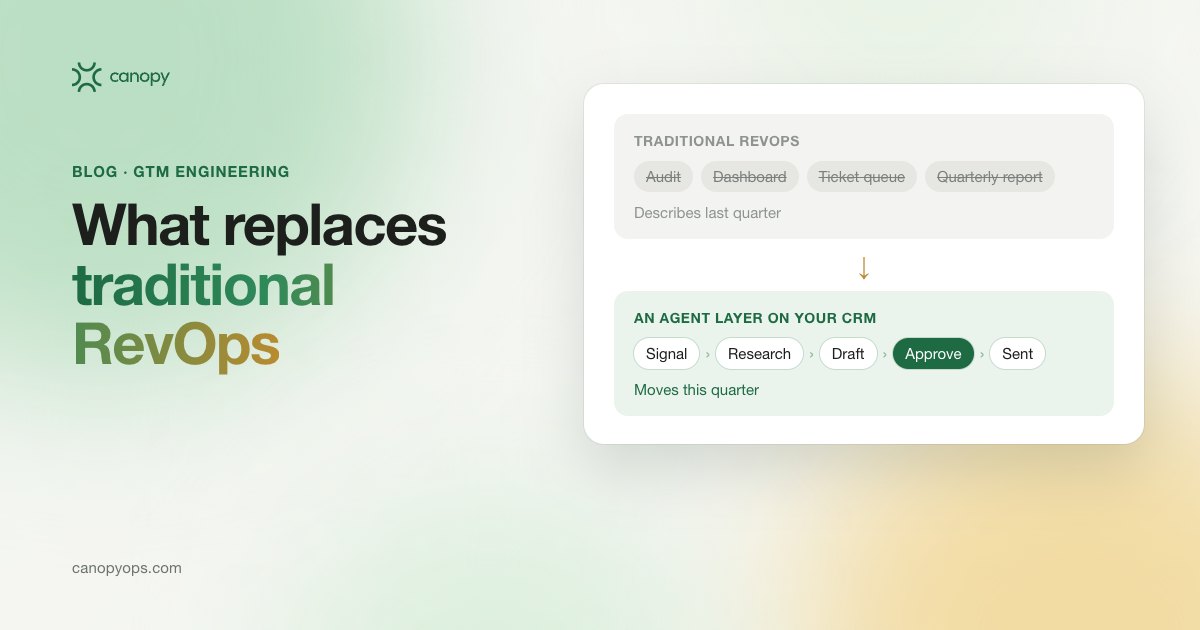
Sales operations is the narrowest of the three. HubSpot's revenue operations guide (updated July 2026) describes sales ops as narrow by design, covering pipeline management, quota setting, CRM hygiene, forecasting and rep enablement, while RevOps owns the full customer lifecycle from first marketing touch to renewal and expansion. Forrester's Jerry Zhao, in an August 2024 Forrester blog post, calls revenue operations "a highly configured, iterative commercial execution strategy" that unifies data, processes, technology and talent across the customer lifecycle. Canopy's guide to revenue operations covers the RevOps function in full, and why traditional RevOps is dead and what replaces it covers where the function is heading.
| Dimension | Sales operations | Revenue operations | GTM engineering |
|---|---|---|---|
| Scope | The sales team | The full customer lifecycle, from first marketing touch to renewal and expansion | The systems and automation behind go-to-market, across every revenue team |
| Core work | Pipeline management, quota setting, CRM hygiene, forecasting, rep enablement | Shared data, processes and goals across marketing, sales and customer success | Building and automating workflows, integrating tools, owning or optimizing the CRM |
| Duty that sets it apart | Quota setting and rep enablement for the sales team | Forecast accuracy across the revenue team | Shipping working automation |
| What a revenue leader gets | A clean pipeline and quota plan | One set of revenue numbers everyone plans from | Routing, lists, sequences and workflows that run without manual effort |
| Main source | HubSpot (2026) | HubSpot (2026), Forrester (2024), Bloomberry (2025) | Bloomberry (2025) |
When the difference between GTM engineering and RevOps matters
The line between GTM engineering and RevOps matters most when a company decides who to hire next. A team with an unreliable forecast and fuzzy stage definitions needs RevOps thinking first, because automation built on unclear process only repeats the confusion at higher volume. A team with clear process and a backlog of manual work needs build capacity, and build capacity is the GTM engineer's job. The signs of that backlog are familiar: lists built by hand, leads routed by a person reading a spreadsheet, and follow-ups that depend on someone remembering. Many companies need both and can fund only one seat, which is where the question of hiring or buying begins.
How to hire a GTM engineer or buy the capability
Companies get GTM engineering capacity in four ways, set out in the table below. The right choice depends on how much build work is waiting, how soon it has to ship and who maintains it once the first version is live.
| Option | What you get | What to watch |
|---|---|---|
| Hire a full-time GTM engineer | One owner for the stack, inside the team | A small candidate pool for a young title, and a ramp period before the first builds ship |
| Grow one from RevOps or sales ops | Someone who already knows your process and your data | Build work competes with forecasting and reporting for the same week |
| Contract a defined project | A scoped build, such as a CRM migration or new lead routing | Nobody owns the workflows once the contract ends |
| Buy a system run by GTM Engineers | Agents built on your CRM, plus a pod of GTM Engineers who run them with your team every week | Your team approves what the agents send and joins a weekly review |
What to look for when hiring a GTM engineer
Hiring a GTM engineer starts with the pay levels already in the market. Bloomberry found a median salary of $127,500 among GTM engineer postings that published a range, based on 2024 and 2025 listings, and the Together AI posting lists $160K to $190K plus equity for its US base. Posted ranges are a partial sample, so treat both figures as reference points. In interviews I look for four signs. The candidate has rebuilt something that broke in production. They can explain a CRM data model out loud, write down what a workflow does before building it, and test on a few records before running on thousands. Tool names on a resume matter less, because the tools change every year and the habits carry over.
Growing a GTM engineer from RevOps or sales ops
Growing a GTM engineer from an existing RevOps or sales ops hire works when that person already knows the CRM and the sales process. Bloomberry's finding that most GTM engineer duties also appear in RevOps engineer postings suggests the step is shorter than the title change implies. The gap to close is usually technical: SQL for pulling and checking data, some scripting, and the discipline to version and test workflows. Time is the bigger risk. A RevOps lead who also owns the forecast will push build work down the list every month-end, so a fixed share of the week for building belongs in the job description.
Buying GTM engineering inside an agentic revenue system
Buying GTM engineering as part of a system suits teams that need both the build and the ongoing running and can't wait a hiring cycle for either. Canopy, the agentic revenue system, works this way. Canopy started as GTM Engineers building revenue systems inside client CRMs, then built the software. Every deployment now gets a pod of GTM Engineers who build the client's agents and then run them with the client's team after launch, with HubSpot staying the source of truth. For RevOps leaders weighing this route, Canopy for RevOps teams sets out what the pod takes on and what stays with the client's team.
How GTM Engineers work at Canopy
At Canopy, GTM Engineers build each client's agents and then run them with the client's team every week, with a founder in the weekly review. Our GTM Engineers connect the tools, write and version the briefs the agents work from, set up the approval queues and send modes, set up experiments and holdouts, and report against the baseline every week. On outbound, the pod also builds and refreshes the ICP, signal definitions and exclusion rules, and watches deliverability and daily volumes. The client's reps approve what sends. Jon Farrar or I sit in the weekly review. The work is GTM engineering as this guide describes it, with agents as the thing being built and tuned.
The weekly, monthly and quarterly rhythm at Canopy
Canopy's GTM Engineers work to a fixed rhythm. A weekly review covers results, approvals, objections and next week's changes. A monthly sprint adds new plays, tunes agents and tests each change against a holdout. Once a quarter, a business review with a founder looks back at results and sets the next quarter's priorities. Message changes wait for a person to accept them: each week Learnings proposes the winning version with its evidence, and one click applies it. The cadence means every message change has evidence behind it and a person who chose to ship it.
The deployment path from workshop to quarterly waves
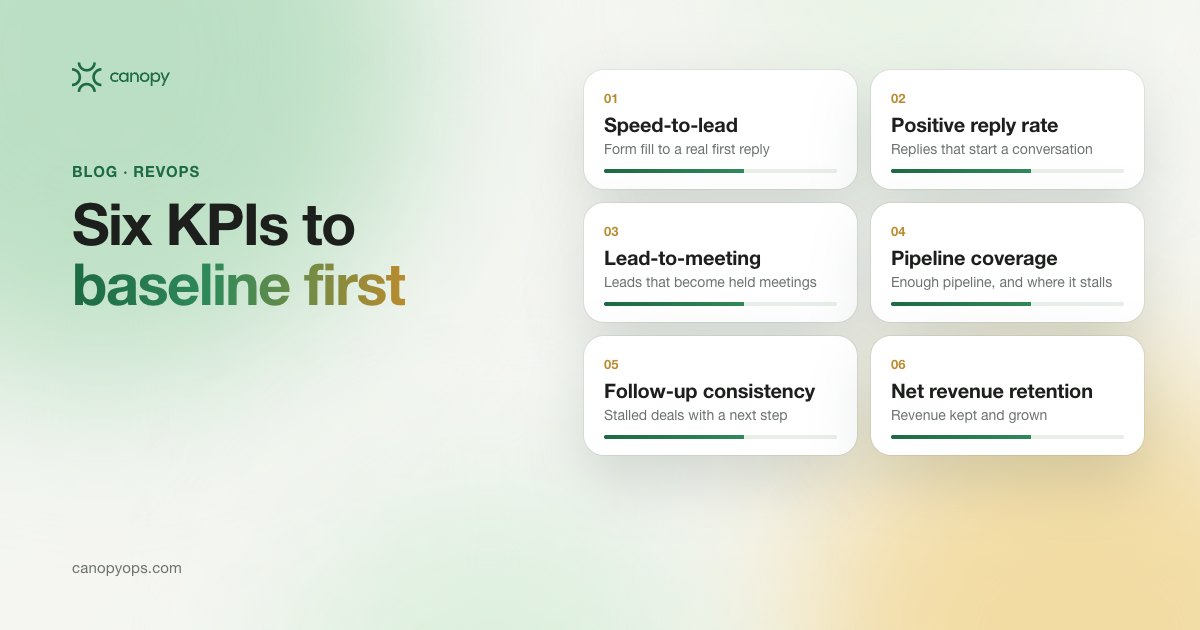
A Canopy deployment follows the same path every time. A revenue workshop in week 0 comes first, then a 30-day build of every workspace with baselines recorded, then a 90-day adoption period (days 30 to 120) with GTM Engineers in the weekly review, then quarterly waves that add new plays. The baselines follow the six KPIs to baseline before you buy another GTM tool. During setup the pod connects the CRM, mailboxes and call recordings, runs a health check of the CRM data and takes a before-and-after snapshot before the client signs off a plan. Before anything sends automatically, the team rates 10 sample drafts, with 8 needed to pass, and a person reads the first 20 drafts of every automatic campaign. The Canopy deployment plan lays out each phase.
Who approves what Canopy's agents send
The client's team approves and sends, and Canopy's GTM Engineers set up what the agents may do. Each workspace runs in one of three send modes: Draft only, Approve to send or Automatic. Send modes are set per workspace, and every change is logged with who made it and when. Only the GTM Engineers on a client's deployment can see that client's data, and every client runs on a private instance, as the Canopy security overview explains. The split keeps people on the client's side in charge of what reaches buyers, in whichever send mode they choose.
How AI agents change GTM engineering
AI agents shift what a GTM engineer builds. A workflow follows rules a person wrote line by line. An agent researches an account, drafts a message and proposes the next step, so the GTM engineer's work moves toward writing the brief the agent follows, setting what it may do without approval and measuring whether its output wins. The GTM engineer still owns the CRM build and the data quality underneath, because an agent acting on a bad record does more damage than a workflow that skips it. The guide to AI sales agents covers what those agents do across the sales cycle.
GTM engineers who work with agents add editorial skills to the technical ones. They read drafts, write voice rules, set the confidence level below which a person must review, and pick which experiments run each week. In my view the job gets more interesting and more accountable at the same time. Teams that adopt agents without anyone in that seat risk a burst of volume followed by drift, because nobody is tuning the output against a baseline.
Frequently asked questions about GTM engineers
What is a GTM engineer, in plain terms?
A GTM engineer is the person who builds and automates a company's go-to-market systems, including CRM workflows, lead routing, data enrichment and outbound sequences, and keeps them running. GTM engineering is the function that owns that build work. Revenue operations owns process, forecasting and reporting, and the GTM engineer ships the automation that marketing, sales and customer success run on.
Is a GTM engineer the same as a RevOps engineer?
A GTM engineer and a RevOps engineer share most of their duties. Bloomberry's 2025 analysis of job postings found that 9 out of 10 GTM engineer responsibilities also appear in RevOps engineer postings. Forecasting is where they split: forecast accuracy appeared in 76% of RevOps postings and is the duty that sets RevOps apart. RevOps owns the numbers and the process, and the GTM engineer builds the systems underneath.
Do GTM engineers need to know how to code?
Some GTM engineer roles require coding, and many don't. Bloomberry found SQL and Python each appeared in 38% of GTM engineer job postings, so most postings didn't list SQL and most didn't list Python. The coding in these roles is practical: querying data, cleaning lists and writing small scripts where a no-code tool falls short. Owning or optimizing the CRM ranked among the top responsibilities in the same analysis.
Which tools do GTM engineers use most?
CRMs top the list of tools in GTM engineer job postings. In Bloomberry's analysis, HubSpot appeared in 52% of postings, Outreach in 49%, Salesforce in 45%, Zapier in 39%, Gong in 23% and Looker in 17%. The mix changes from company to company, and the CRM stays at the center because that is where a GTM engineer's routing, lists and workflows land.
How much experience do GTM engineer jobs ask for?
GTM engineer jobs ask for about four years of experience on average. Bloomberry found the average posting asked for 4.11 years. A live Together AI posting asks for 3 to 5+ years in a Growth, GTM engineer or Revenue Operations role, which shows employers accepting adjacent backgrounds, since the GTM engineer title itself only spread between 2023 and 2025.
How much does a GTM engineer earn?
Posted GTM engineer salaries point to a median of about $127,500. Bloomberry found that median among GTM engineer postings with a public salary range, based on 2024 and 2025 listings. A live Together AI posting lists a base salary of $160K to $190K plus equity for its US-based role. Posted ranges are a partial sample of the market, so use them as reference points when setting a band.
When should a company hire its first GTM engineer?
A company should hire its first GTM engineer when its sales process is clear but manual work keeps piling up: lists built by hand, leads routed by a person and follow-ups that depend on memory. If the forecast is unreliable and stage definitions are fuzzy, RevOps work comes first, since automation copies whatever process it is given. A company that can fund only one seat can also compare hiring with buying a system that comes with GTM Engineers.
Can someone in RevOps or sales ops become a GTM engineer?
Someone in RevOps or sales ops can become a GTM engineer, and job postings already accept that path. The Together AI posting asks for experience in a Growth, GTM engineer or Revenue Operations role. The gap is usually technical: SQL, light scripting and the habit of versioning and testing workflows before they touch live records. Protected time for build work matters as much as the skills, because forecasting and reporting tend to crowd it out.
What's the difference between a GTM engineer and a sales engineer?
A sales engineer supports individual deals, and a GTM engineer supports the system every deal runs through. Sales engineers, sometimes called solutions engineers, work with prospects during the sale, running technical demos and answering product questions. A GTM engineer works inside the company, building the workflows, data and automation that marketing, sales and customer success depend on, and rarely speaks to a prospect.
What do Canopy's GTM Engineers do?
Canopy's GTM Engineers build each client's agents and then run them with the client's team every week, with a founder in the weekly review. The pod connects the tools, writes and versions the briefs the agents work from, sets up approval queues and send modes, and reports against the baseline each week. The client's reps approve what sends, and every client runs on a private instance.
Will AI agents make GTM engineers unnecessary?
AI agents give GTM engineers more to own. Agents move a GTM engineer's work toward writing the briefs they follow, setting what they may do without approval and measuring whether their output wins. Someone still has to own the CRM build and the data underneath, and an agent acting on a bad record does more harm than a workflow that skips it. Agents need an owner, and the GTM engineer is the natural one.
Written by John Miraglia, Co-Founder of Canopy, who leads product and platform. John built and exited a B2B SaaS company by automating every step of the pipeline instead of hiring more reps. Last updated: November 2026.
Canopy comes from the team behind Sprig and Stability AI, and its agentic revenue system is open to a small group of launch partners. Teams that want GTM Engineers to build agents on their HubSpot and run them alongside their reps every week can apply to become a launch partner.
RevOps and leadership
See how Canopy puts this to work on top of HubSpot, with your team approving what sends.