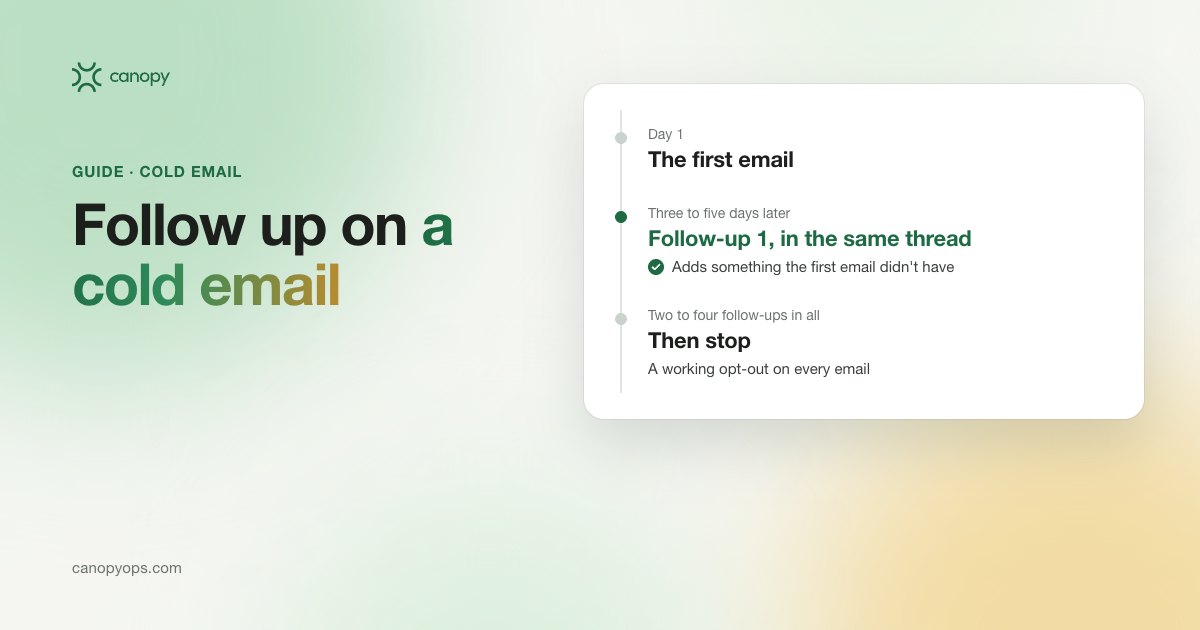
Follow up on a cold email two to four times over about two weeks, leaving three to five days between touches. Each follow-up should add one new thing, such as a proof point, a fresh angle or a short check-in, and the last one closes the loop. Stop the sequence at any reply or opt-out.
Key takeaways on cold email follow-up
- Follow-ups bring in a large share of cold email replies: in Belkins' 2026 study of 7.5 million emails it sent in 2025, steps 2 through 6 together produced 58.6% of all replies.
- Two to four follow-ups after the first email is a sensible cap for a B2B cold sequence, because unsubscribes climb and replies thin out as a sequence runs long.
- No public primary study sets the ideal number of days between cold email follow-ups; a gap of three to five days is common practice.
- A good follow-up adds something the first email didn't have and sits in the same thread.
- The US CAN-SPAM Act covers business-to-business email, so every follow-up needs a working opt-out that you honor within 10 business days.
How many follow-ups should you send after a cold email?
Two to four follow-ups after the opening email, so three to five emails in total, is where I'd set the cap for a B2B cold email sequence. The public studies measure different things, yet they point the same way: follow-ups add replies, and the gains shrink after the third or fourth one. Stop after one follow-up and you leave replies unclaimed. Go past four and you mostly collect unsubscribes and spam complaints.
| Study | Data behind it | Finding on follow-ups | Caveat |
|---|---|---|---|
| Backlinko, 2019 | 12 million outreach emails, data from the outreach software company Pitchbox | One more follow-up boosted replies by 65.8%; emailing the same contact several times led to 2x more responses | Link-building outreach from 2019 |
| Hunter, State of Cold Email 2025 | 11 million cold emails sent in 2024 on Hunter's platform, plus a survey of 217 decision-makers | Campaigns with follow-ups averaged a 4.9% reply rate, against 3% without | Hunter's own platform data |
| Belkins, 2026 | 7.5 million emails Belkins sent in 2025 | Steps 2 to 6 produced 58.6% of replies; step 3 alone booked more appointments than steps 1 and 2 | Belkins' own campaigns; replies counted over all sent emails |
What the cold email follow-up studies show
Only 8.5% of all the emails in Backlinko's 2019 analysis of 12 million outreach emails got any response, and Hunter's State of Cold Email 2025 report puts the average cold email campaign reply rate at 4.1%. In Belkins' own 2025 sends, the first email had the highest reply rate of any single step, at 0.59%, yet most replies came later. Belkins, a B2B lead-generation firm, counts unique replies over every email sent, so its rates look far lower than Hunter's. Read each study on its own terms and don't line their reply rates up against each other.
Why more than four follow-ups rarely pays off
Hunter reports that unsubscribe rates grow after the third follow-up, and Belkins found that email returns diminish fast beyond step 5. Hunter doesn't publish a reply-rate cutoff, so the cap of four is my judgment from both datasets. If a prospect hasn't answered four well-spaced emails that each said something new, a fifth won't change much. Park the account and come back with a new sequence when something real changes at the company, like a new leader in the team you sell to.
How long to wait between cold email follow-ups
Three to five days between cold email follow-ups is common practice, with a shorter gap after the first email and longer gaps later. No openable primary study fixes the ideal gap in days, so treat any exact spacing, mine included, as a starting point to test against your own replies. I'd start with the first follow-up three days after the opener, the next four days after that, and the closing email about five days later, so the sequence runs about two weeks. Stretch it to three weeks for buyers who travel a lot. Squeezing it into one week reads as pressure.
How quickly do people reply to email?
Most email replies come fast. A Yahoo Labs study of 16 billion emails exchanged by more than 2 million Yahoo Mail users, presented at the WWW conference in 2015, found that more than 90% of replies happen within a day of receiving the message. The most likely reply time was two minutes, and half of all replies arrived within 47 minutes. The study covers everyday person-to-person email, so it can't serve as a cold email benchmark. The practical reading still holds: if a prospect hasn't answered within a day or two, your email was most likely missed or pushed down the list. A follow-up three days later works on that assumption.
Timing details that matter more than the exact gap
I'd get these cold email timing habits right before worrying about the exact gap. Send during working hours in the recipient's time zone, and skip weekends for business buyers. Keep every follow-up in the same thread as the first email, so the subject reads "Re:" and the original note sits underneath. Don't stack two touches on the same day across channels; a LinkedIn request and an email an hour apart feel like a campaign aimed at one person. When someone sends an out-of-office reply, hold the next step until after their return date.
How to follow up on a cold email, step by step
A cold email sequence works best when every step has its own job. The five steps below fit the two-to-four follow-up cap and the spacing above. Adjust the days to your buyers, but keep the order of jobs.
- Send an opener built on one specific reason to write.
- Follow up with a proof point and a one-line ask.
- Add a LinkedIn connection request, sent by the rep.
- Send a two-line check-in.
- Close the loop and leave the door open.
Step 1: send an opener built on one specific reason
The first email in a cold sequence earns the follow-ups that come after it. Open on one reason you are writing to this person now: a role they are hiring for or a problem their team has talked about in public. Name the problem you solve in one sentence and ask a question they can answer in a few words, all in under 100 words. A first email that could go to anyone gives the follow-ups nothing to build on. Our guide to AI SDRs covers how research on each account feeds that opening line when software drafts it.
Step 2: follow up with a proof point and a one-line ask
The first cold email follow-up, about three days after the opener, gives the prospect a reason to believe the first email. Add one piece of proof: a short outcome from a similar company or a public number about the problem. Then repeat the ask in one line. Don't summarize the first email, which sits right underneath in the thread, and don't spend this slot on "just bumping this to the top of your inbox".
Step 3: add a LinkedIn connection request
A LinkedIn connection request a day after the first follow-up puts a face to the name in the inbox. The rep sends it personally, with a short note or none at all, and without a pitch. Mention the email in a few words so the request doesn't look random. If the prospect accepts, resist sending a sales message on LinkedIn the same day; let the email sequence carry the ask.
Step 4: send a two-line check-in
The third email can be the shortest in the sequence: two sentences asking whether they saw your note, with an easy way to say no. A short check-in costs the prospect almost nothing to answer. I'd rather get a clear no than silence, because a no tells you to stop and frees the rep for accounts that might say yes.
Step 5: close the loop and leave the door open
The last email in a cold sequence tells the prospect you'll stop, and means it. Say you haven't heard back, assume the timing is wrong, and tell them how to restart the conversation if that changes. Ask, optionally, whether someone else owns the problem. A respectful last email matters if you want to write to the same company again in six months. After it, take the contact out of active outreach.
Cold email follow-up examples you can copy
The five cold email follow-ups below are short on purpose. Replace every bracket with something true about the account, and cut any sentence you can't make specific. Each email goes as a reply in the same thread as your first email, so the subject stays as "Re:" plus your original subject. Follow-up after a sales call is a different job, with a promise to keep, and our guide to AI sales follow-up covers it.
Example 1: the proof-point follow-up
Subject: Re: [original subject]
Hi [first name], one more thing on [the problem from your first email]. [Similar company] had the same issue when [situation], and [what changed for them, in one line]. Worth 15 minutes to see whether the same applies at [company]?
Send the proof-point follow-up around day 3. The proof must be real and checkable; without a customer example, use a public fact about the problem.
Example 2: the new-angle follow-up
Subject: Re: [original subject]
Hi [first name], I noticed [company] is [hiring for role / launching product / opening a new market]. Teams at that stage usually run into [specific consequence]. If [problem] is on your list for [quarter], I can send over [one useful thing, such as a checklist or a short teardown].
Use the new-angle follow-up when you have a second, different reason to write.
Example 3: the two-line check-in
Subject: Re: [original subject]
Hi [first name], did you get my note below about [topic]? If it isn't a priority right now, a one-word "no" is fine and I'll stop there.
Send the two-line check-in around day 7. Resist adding a third sentence.
Example 4: the LinkedIn connection note
Hi [first name], I emailed you this week about [topic] at [company]. Glad to connect here either way.
The rep sends the LinkedIn note personally, the day after the first follow-up. Keep the pitch in email.
Example 5: the close-the-loop email
Subject: Re: [original subject]
Hi [first name], I haven't heard back, so I'll assume [problem] isn't a priority right now and stop emailing about it. If that changes, reply to this thread and I'll pick it up. And if someone else at [company] owns [area], a name would help.
The close-the-loop email goes out last, around day 12. After it, remove the contact from active outreach.
When to stop following up on a cold email
Stop the sequence for a contact the moment they reply, whatever the reply says. A positive reply needs a person quickly, and the case for answering fast is the same one we make for speed to lead on inbound. An objection needs a considered answer, and an opt-out must be honored. Letting the next scheduled step fire after someone has answered is the fastest way to lose a prospect who was ready to talk. The other stopping point is the end of the sequence: after the close-the-loop email, the contact leaves active outreach.
| Reply | What to do with the sequence | Next action |
|---|---|---|
| Positive reply | Stop it | Answer the same day with a booking link or two times |
| Objection | Stop it | Answer the objection in a personal reply |
| Out of office | Pause it | Resume with the same step after the return date |
| "Not now" | Pause it | Pick up again on the date they gave, or a few months out |
| Unsubscribe or "remove me" | Stop it for good | Honor within 10 business days and mark the contact do-not-email in your CRM |
| No reply after the last email | End it | Leave the account alone until something changes at the company |
What an out-of-office or "not now" reply means for the sequence
An out-of-office reply and a "not now" reply both pause the sequence for a set time. An out-of-office message tells you when the person is back, so hold the next step until that date and then send the step they would have received anyway. A "not now" is a real answer with a time attached: thank them, ask when to check back if they didn't say, and set that date. Sending on schedule after either reply turns a warm contact cold.
Cold email follow-up rules: CAN-SPAM and Google's sender requirements
CAN-SPAM's rules apply to every email in a cold sequence, follow-ups included, and Google's rules apply to every message a bulk sender sends. None of this is legal advice; check the sources below and your own counsel for your situation and region.
What CAN-SPAM requires of every follow-up
The US Federal Trade Commission says in its CAN-SPAM compliance guide for business (2023, edited January 2024) that the law makes no exception for business-to-business email. Under CAN-SPAM, a sender must honor an opt-out request within 10 business days and keep the opt-out mechanism working for at least 30 days after sending. Each email must include a valid physical postal address and must not use a deceptive subject line. Each email that breaks the rules can draw a penalty of up to $53,088, a figure the FTC adjusts for inflation. For a sequence, every step carries the same opt-out and address as the opener, and an opt-out on any step stops every later step.
What Google requires from senders to Gmail
Google's email sender guidelines require anyone sending more than 5,000 messages a day to Gmail accounts to authenticate with SPF, DKIM and DMARC, support one-click unsubscribe on marketing messages, and keep the spam rate reported in Postmaster Tools below 0.10%, never reaching 0.30%. The requirements started on 1 February 2024. For follow-ups, the spam-rate ceiling is the number to watch, because a sequence that runs too long gives uninterested prospects more chances to report it.
Canopy's default follow-up play: one worked example
Canopy's default outbound play is five touches over 12 days: four short emails and one LinkedIn connection request that the rep sends themselves. I'm including it as one worked example of the spacing above. The play is Canopy's default, and no study proves it is the best possible sequence. Each play carries its own sequence, with day, channel and purpose editable per step. SDR teams can read more on Canopy for sales development.
| Day | Channel | What the touch does |
|---|---|---|
| Day 0 | Opens on the signal that put the account in the play | |
| Day 3 | Adds a proof point and a one-line ask | |
| Day 4 | A connection request the rep sends; nothing posts on their behalf | |
| Day 7 | A short "did you get my note" | |
| Day 12 | Closes the loop |
How Canopy drafts and approves each follow-up
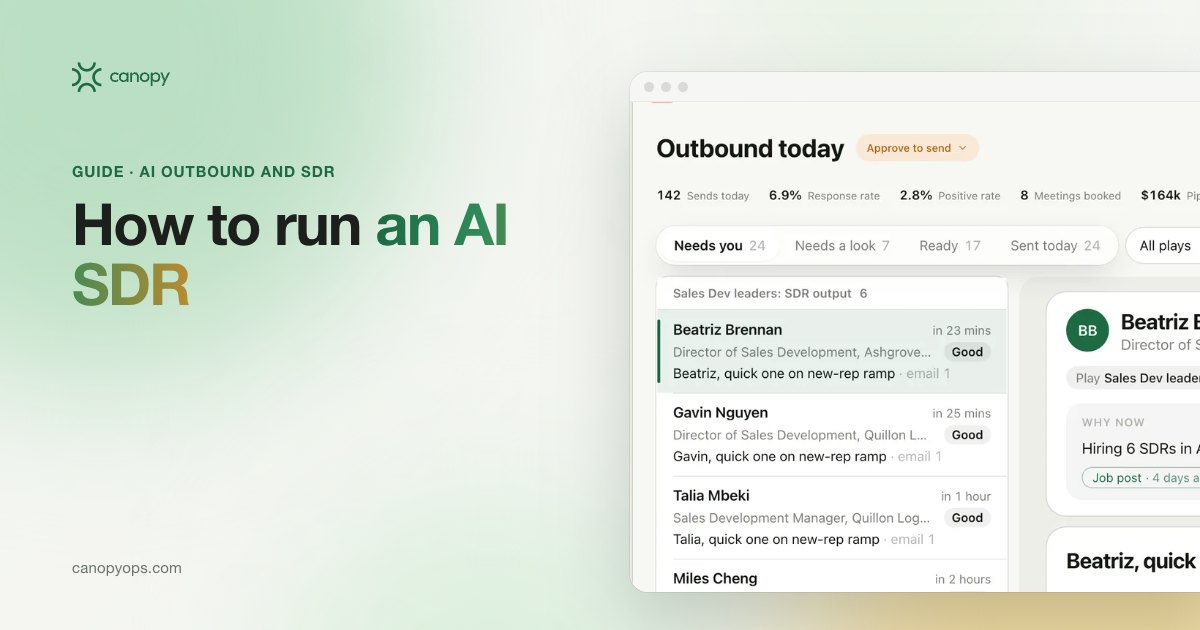
In Canopy's Outbound workspace, each follow-up is drafted for that account, cites what it says, and waits in the rep's queue like the first email. The second email can reference a recent pricing-page visit or a proof point; later emails can reference funding or open roles. Every email is its own draft with its own confidence score and approval, labeled email 1, email 2 and so on in the queue. On Approve to send, every queued email waits for a click. A team can move a workspace to Automatic, where drafts at 85% or above send on schedule, as our page on agent control and send modes explains.
How Canopy stops or pauses a sequence when someone replies
Any reply pauses the Canopy sequence for that account. An out-of-office picks it up again on the return date with the same step, a not-now picks it up months later on a date shown in the Inbox, and an unsubscribe stops it for everyone at the company and marks the contact Do not email in HubSpot. Canopy sorts replies into five classes (positive, objection, out of office, not now and unsubscribe), each with a confidence score and the reason. Positive replies land in the rep's Inbox with a suggested answer and a booking link. Objections come with a suggested handle. The rep can edit either before sending.
Timing guardrails in Canopy's outbound plays
Canopy's plays send only between 8 a.m. and 5 p.m. in the recipient's local time, under a daily cap, with a 45-day cooling-off period after any send. Workspace-wide quiet hours run from 6 p.m. to 7 a.m. recipient time. Each draft shows when it will send, with the reason for that time. A pod of GTM Engineers runs the setup with your team, as described in how a Canopy deployment runs. Collision rules keep one contact from getting two sequences at once: one active play per contact, contacts already receiving Lifecycle emails wait until that program finishes, and accounts an account executive owns need that person's approval before anything sends.
How to tell whether your cold email follow-ups are working
Measure follow-ups by step, on replies, positive replies and meetings booked, never on opens. A reply rate for the whole sequence hides which step pulls its weight; a rate per step tells you whether step 4 earns its place or only adds unsubscribes. Write down your current numbers before you change anything, as we describe in the KPIs to baseline before buying sales tools, then change one thing per step, such as the subject line or the opener. Canopy measures outbound on replies, positive replies, meetings and pipeline, and compares each sequence's versions with the winner marked and a note on why. Each week Learnings proposes the winning version of a message with its evidence, and one click applies it.
Cold email follow-up questions
How many times should you follow up on a cold email?
Send two to four follow-ups after a cold email, spaced three to five days apart over about two weeks, then stop. Belkins' 2026 study of its own sends found steps 2 to 6 produced 58.6% of replies, while Hunter reports unsubscribe rates grow after the third follow-up. Each follow-up should add something new, and the last one should close the loop politely.
How long should I wait before sending the first follow-up?
Wait two to three working days before the first follow-up. A 2015 Yahoo Labs study found more than 90% of email replies happen within a day, so silence after a day or two usually means the email was missed. No primary study sets an exact gap for cold email, so treat three days as a starting point and test it.
What should a cold email follow-up say?
A cold email follow-up should add one thing the earlier emails didn't have: a proof point, a new reason you are writing, a useful resource or a simple question. Keep it under 75 words and in the same thread. Avoid "just bumping this", which repeats your ask without giving the prospect a new reason to answer.
Should a follow-up be a new email or a reply in the same thread?
Send follow-ups as replies in the same thread as your first email. The subject reads "Re:" and the original note sits underneath, so the prospect has the context without you repeating it. Start a new thread only when you begin a new sequence months later with a different reason to write.
Is it rude to follow up on a cold email more than once?
Following up more than once is normal and expected in B2B sales, as long as each email is short, relevant and easy to decline. Backlinko's 2019 study found that emailing the same contact several times led to 2x more responses. Rudeness comes from volume and sameness: five identical bumps, or emails that ignore a reply.
How do you end a cold email sequence politely?
End a cold email sequence with a close-the-loop email that says you'll stop writing, assumes the timing is wrong, and explains how to restart the conversation. Optionally ask whether someone else owns the problem. Then take the contact out of active outreach and only come back when something real changes at the company.
Do cold email follow-ups need an unsubscribe option?
Yes. The FTC says CAN-SPAM makes no exception for business-to-business email, so every follow-up needs a working opt-out, honored within 10 business days, plus a valid postal address. Google also requires one-click unsubscribe on marketing messages from anyone sending more than 5,000 messages a day to Gmail accounts.
What reply rate should I expect from cold email follow-ups?
Hunter's State of Cold Email 2025 report, based on its own platform data, puts the average cold email campaign reply rate at 4.1%, and 4.9% for campaigns with follow-ups against 3% without. Other studies count replies differently, so compare your numbers with your own past campaigns.
Is it true that 80% of sales need five or more follow-ups?
No traceable study supports the claim that 80% of sales are made on the fifth to twelfth contact. VentureBeat reported in 2014 that the figure traces to a "National Sales Executive Association" it could find no record of. Plan your follow-up count from studies you can open and from your own reply data.
Should I follow up on LinkedIn as well as email?
A LinkedIn connection request alongside email follow-ups is a sensible second touch, sent personally by the rep with a short note or none. Place it a day after an email and keep the pitch in email. Canopy's default play includes one LinkedIn request on day 4, which the rep sends themselves.
Can AI write cold email follow-ups that don't sound automated?
AI can draft cold email follow-ups that read as personal when each draft is built from research on that account and a person approves it before it sends, which is how AI sales agents should work in outbound. In Canopy, every follow-up is drafted for the account, cites what it says, and waits in the rep's queue with its own confidence score until the rep approves it.
Written by Jon Farrar, Co-Founder of Canopy, who leads lifecycle and go-to-market and was previously head of marketing for an eight-figure global direct-to-consumer brand. Last updated: November 2026.
Canopy is the agentic revenue system from the team behind Sprig and Stability AI, and we're opening it to a small group of launch partners. If you want every follow-up drafted for the account and approved by your reps before it sends, apply to become a launch partner.
Outbound
See how Canopy puts this to work on top of HubSpot, with your team approving what sends.