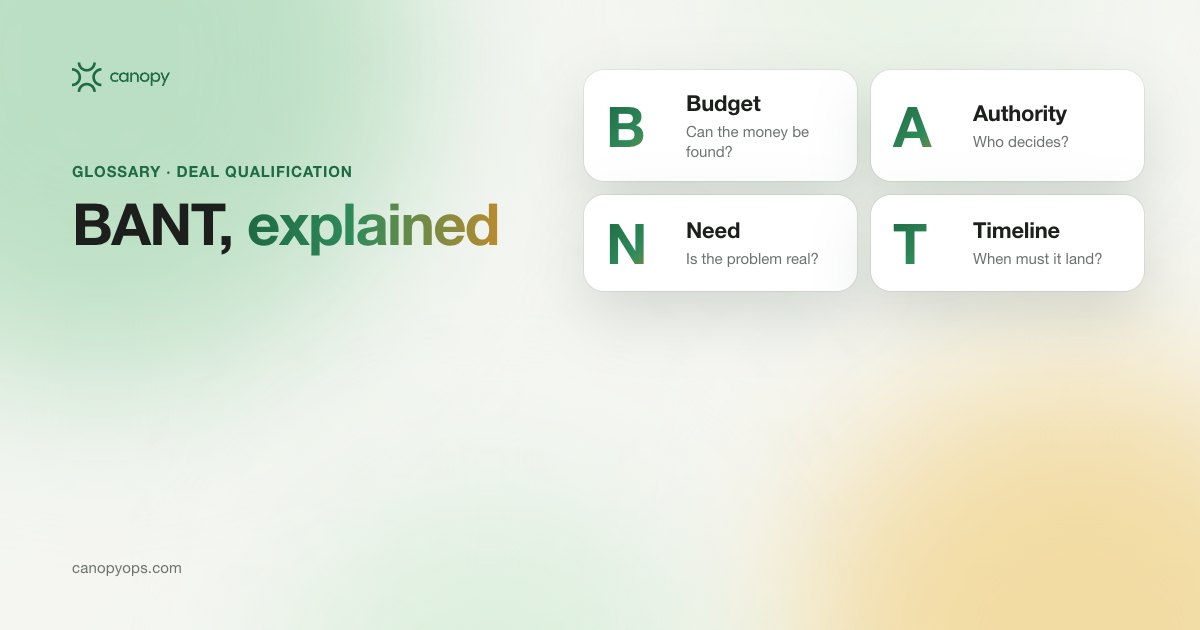
BANT is a sales qualification framework that checks four things before a rep invests in a deal: Budget (can the buyer pay), Authority (who signs), Need (what problem the buyer has to solve) and Timeline (when they plan to buy). BANT is widely attributed to IBM, which required BANT criteria in its partner programs.
Key takeaways on BANT qualification
- BANT asks whether a prospect has the budget, the authority, the need and the timeline to buy, and sales teams use the answers to decide which deals deserve a rep's time.
- IBM's partner program templates made BANT mandatory and rejected opportunity registrations that left the four criteria out, though no IBM document gives a date for when BANT began.
- Authority is BANT's weakest letter, because a single decision maker rarely explains how a buying group reaches a decision.
- CHAMP, ANUM and GPCTBA/C&I reorder or extend the same questions, and MEDDPICC adds the decision process, the paper process and a champion.
- Canopy's Deals coaching view shows how many of six discovery areas, budget and timeline among them, each rep's calls cover; Canopy does not score BANT itself.
What does BANT stand for?
BANT stands for Budget, Authority, Need and Timeline. HubSpot's lead qualification guide (Kiran Shahid, updated June 2026) calls BANT the "Old Faithful" of sales qualification frameworks. IBM's own partner forms spell the last letter "Timeframe", and the two words mean the same thing. Each letter is a question the rep should be able to answer from what the buyer said, before the deal moves to a proposal.
| Letter | What the rep needs to know | A discovery question that gets at it |
|---|---|---|
| B: Budget | Whether money exists, or can be found, for a purchase of this size | How have you paid for tools like this before, and who owns that spend? |
| A: Authority | Who approves the purchase and who signs the contract | Besides you, who needs to agree before this goes ahead? |
| N: Need | The problem the buyer has to solve and what it costs them today | What happens if nothing changes in the next six months? |
| T: Timeline | When the buyer intends to decide, and why that date matters | Is there a deadline or an event driving the timing? |
Where did BANT come from?
BANT is widely attributed to IBM, and IBM's public partner documents show how the company used it. A form titled Budget Authority Need Timeframe (BANT) Criteria Template (version 3.3, undated) declared itself mandatory, with every field required, and said opportunity registrations lacking the customer's budget, authority, need and timeframe would be rejected as incomplete. No IBM page states when BANT began, so the origin dates that circulate online have no primary source behind them.
IBM's Value Advantage Plus template for government sales (version 1.1, undated) set the bar for a validated opportunity: the partner had made at least one sales call and knew the customer's budget, authority, need and timeframe. Marketing campaign and seminar leads did not count. Both IBM templates defined authority narrowly, requiring at least one C-level or line-of-business executive contact and stating that procurement and purchasing contacts were not valid executive decision makers.
How do sales teams use BANT today?
Sales teams use BANT today mostly as a gate between stages. In a common setup, a sales development rep runs the first call, checks the four criteria and only then hands the opportunity to an account executive, which is why sales development teams tend to know BANT best. Inbound teams ask the same four questions to decide which form fills get a call this week and which go to a nurture track. In revenue operations, BANT often turns into stage exit criteria, so a deal can't move to proposal until budget and timeline are recorded in the CRM.
I think BANT works best as a short list a rep must not forget, asked across two or three calls. Reps who run it as a scripted interrogation on call one get guarded answers, especially on budget. The record BANT leaves matters most: in a pipeline review, a manager can see which deals have a named budget owner and a decision date, and which are running on hope.
What are the weaknesses of BANT?
Why authority is BANT's weakest letter
BANT's authority check assumes one person can say yes. Forrester's 2025 report summary "Buying Groups For The Win" (Terry Flaherty and Amy Hawthorne) says that on average 13 people within an organization are involved in a buying decision, and argues that teams must move from qualifying individual leads to engaging multiple buying group members. A rep who ticks Authority after one conversation with a VP has confirmed one opinion out of many. Finance, legal, security and the people who will use the product can each slow or stop a purchase, and none of them fits in a single Authority field.
Why budget is rarely set before the first call
Budget is the letter buyers are least able to answer early. In my experience, B2B buyers seldom hold a line item for a product they have not chosen yet; the money gets found once the need is clear and someone writes the business case. Ebsta's own 2024 B2B Sales Benchmarks, produced with Pavilion, show budget as one loss reason among several: reps attributed 61% of lost deals to indecision, and the common stated loss reasons among average performers were lack of budget (22%), not a priority (20%) and a competitor (14%). Qualifying out on "no budget" at call one throws away deals where the money would have followed the need.
Why BANT's letter order puts need too late
BANT puts need third, after money and authority. A rep who follows the acronym in order asks what the buyer can spend before learning what problem the buyer wants solved, which makes the call feel like a screening interview. CHAMP moves challenges to the front, and ANUM starts with authority. BANT also has no letter for how the buyer will decide, which criteria they will judge vendors on, or what paperwork stands between a verbal yes and a signature. MEDDPICC covers those gaps.
How does BANT compare with CHAMP, ANUM, GPCTBA/C&I and MEDDPICC?
BANT, CHAMP, ANUM and GPCTBA/C&I ask about money, authority, need and timing in different orders and with different additions, and HubSpot's lead qualification guide describes all four. MEDDPICC adds deal mechanics BANT has no letter for. The MEDDPICC definitions below come from MEDDICC's MEDDPICC page; MEDDICC is a company that sells MEDDPICC training.
| Framework | What the letters stand for | How it differs from BANT | Origin, as sources record it |
|---|---|---|---|
| BANT | Budget, Authority, Need, Timeline | The baseline: four checks, money first | Widely attributed to IBM, which required BANT criteria in partner programs |
| CHAMP | Challenges, Authority, Money, Prioritization | Puts the buyer's challenges ahead of authority | Described in HubSpot's lead qualification guide |
| ANUM | Authority, Need, Urgency, Money | Reorders BANT to confirm the decision maker first; urgency replaces timeline | Described by HubSpot as an alternative spin on BANT |
| GPCTBA/C&I | Goals, Plans, Challenges, Timeline, Budget, Authority, Negative consequences, Positive implications | Adds the buyer's goals and plans, and the consequences and implications of acting | Developed at HubSpot |
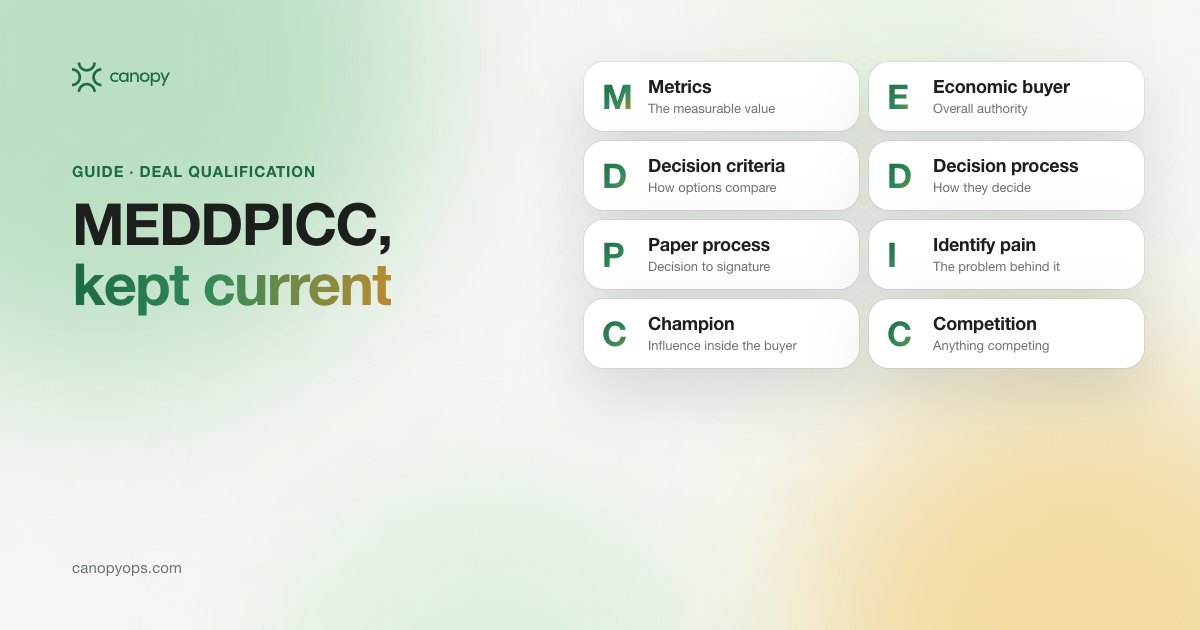
| MEDDPICC | Metrics, Economic buyer, Decision criteria, Decision process, Paper process, Identify (or implicate) pain, Champion, Competition | Adds decision criteria, decision process, paper process, a champion and competition | Began as MEDDIC at PTC in the mid-1990s; later variants added Competition (MEDDICC) and Paper Process (MEDDPICC) |
Choosing between BANT and MEDDPICC
MEDDICC positions MEDDPICC for mid-market and enterprise deals where legal and procurement are involved, and the original MEDDIC for simpler B2B sales with fewer stakeholders. My view: BANT, CHAMP or ANUM suit a first call or an inbound screen, where the job is to decide whether a second conversation is worth having. MEDDPICC suits the deal after that, once several people are involved and a contract has to clear legal. A common setup runs both, with a short BANT-style screen early and MEDDPICC from the first real opportunity stage onward.
How does AI change BANT qualification?
AI turns BANT from a form a rep fills in from memory into a check against what the buyer said on the call. When software reads every call, a manager no longer depends on the rep's notes to know whether budget came up, because the call record shows it. Coverage becomes measurable per rep, so you can see who asks about timeline and who skips it. Answers also stay tied to evidence, which means a yes on authority can be traced back to who said what. The judgment stays human. Whether "maybe next quarter" counts as a real timeline is still a call for the rep and the manager. The same split, with agents gathering and drafting and people deciding, runs through how AI is used across the sales process.
Where Canopy's Deals workspace fits with BANT
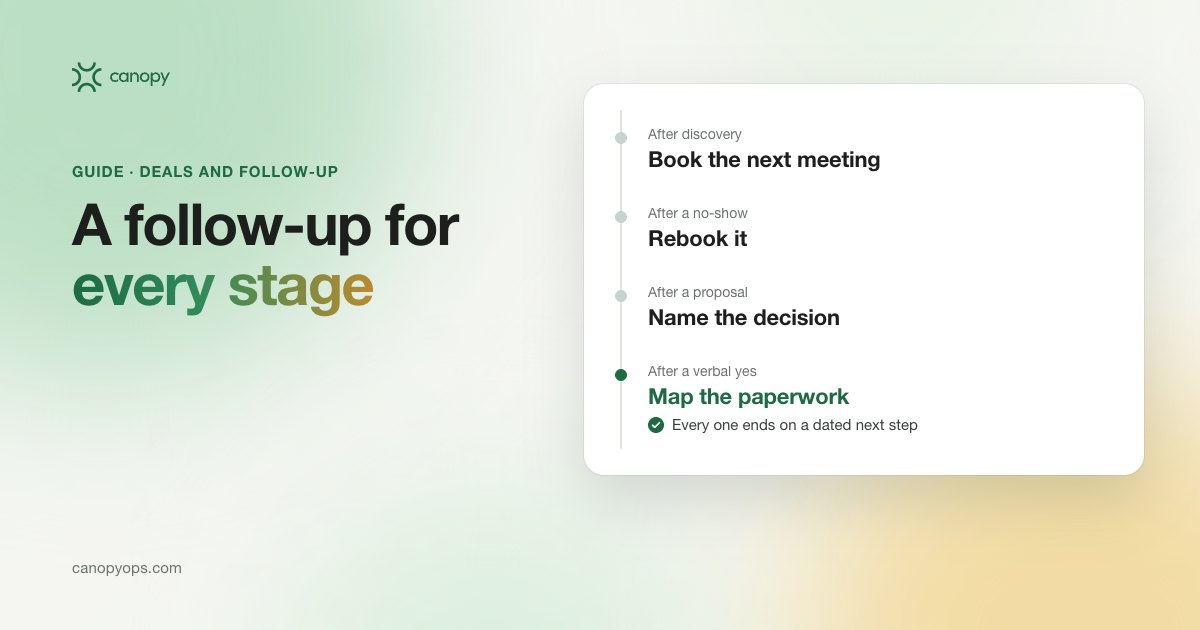
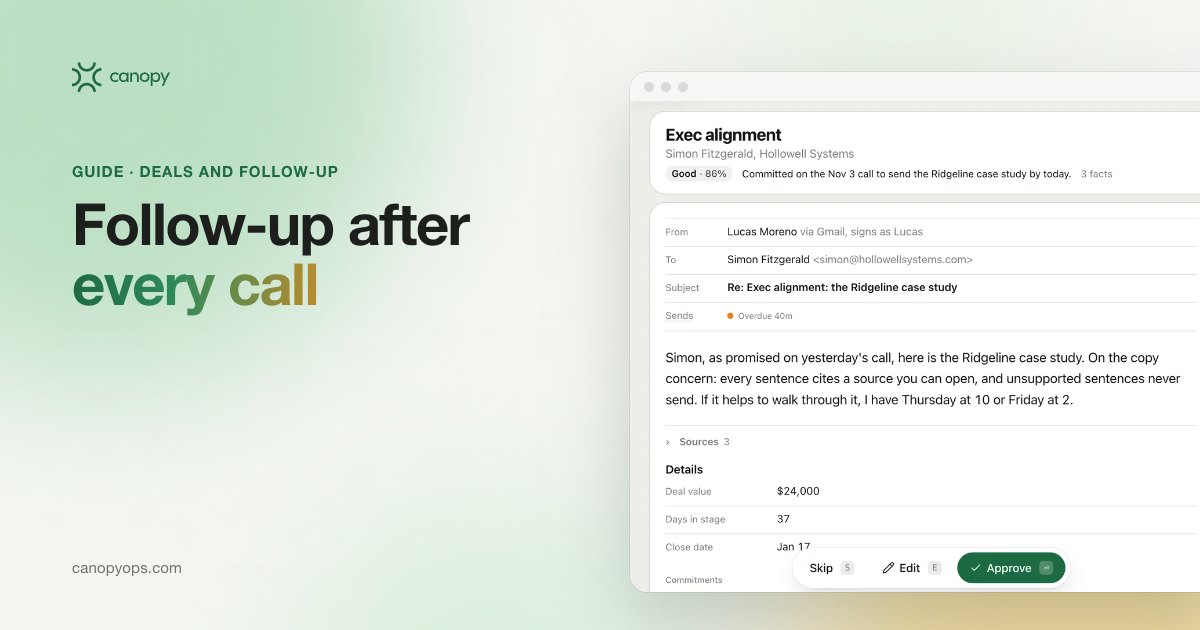
Canopy's Deals workspace reads each sales call and pulls out a short summary, the commitments made on both sides (who, what, by when, and whether each is open or done), the objections raised and the agreed next steps. The summary and the extracted items sit on the deal in Canopy, beside the follow-up email Deals drafts for the rep, which is the subject of our guide to AI sales follow-up after every call. For BANT, an objection about price or a commitment to bring finance into the next call by a set date lands on the deal as the buyer said it.
Canopy's coaching view scores discovery depth: how many of six discovery areas a rep's calls cover, on average. The six areas are pain, current process, budget, timeline, decision process and success criteria. Mapped against BANT, budget and timeline match two letters directly and pain sits close to need; authority has no area of its own, and the decision process is the nearest one. The recommendation the coaching view shows reads: "Budget and timeline are the areas most often skipped. Ask them before pricing." Coaching also shows talk ratio, questions per call, when pricing first comes up and next-step clarity for each rep.
Canopy does not score BANT, fill BANT fields or write qualification data to your CRM. Deal stages change in HubSpot, where the Update stage button opens the deal, and the rep decides whether a deal is qualified. Deals is one part of Canopy's agentic revenue system, which a pod of GTM Engineers builds and runs with your team under Canopy's deployment model, with a founder in the weekly review.
Common questions about BANT
What is BANT in sales?
BANT is a four-part checklist sales reps use to qualify a prospect: Budget, Authority, Need and Timeline. A deal passes BANT when the rep knows whether the buyer can pay, who approves the purchase, what problem it solves and when the buyer plans to decide. IBM required BANT criteria in its partner programs, and the framework is widely attributed to IBM.
Is BANT still used, or is it outdated?
BANT is still in wide use, usually as an early screen on first calls and inbound leads. HubSpot's lead qualification guide says BANT is widely used and calls it the "Old Faithful" of qualification frameworks. Its limits show in larger deals: one Authority check does not cover a buying group, and budget is often found after the need is clear. Teams with multi-stakeholder deals can pair BANT with a deeper framework such as MEDDPICC.
What is the difference between BANT and MEDDPICC?
BANT checks four basics (budget, authority, need, timeline), and MEDDPICC tracks eight elements of how a deal will close: metrics, economic buyer, decision criteria, decision process, paper process, pain, champion and competition. MEDDICC, which sells MEDDPICC training, positions MEDDPICC for mid-market and enterprise deals that involve legal and procurement. BANT fits an early screen, and MEDDPICC fits a live opportunity with several people involved.
Who created BANT?
No public primary source names the person who created BANT or the year it began. BANT is widely attributed to IBM, and IBM's public partner program templates show the company required BANT criteria and rejected opportunity registrations that lacked them. Any origin date you read online has no IBM document behind it, so treat those dates with caution.
Does the T in BANT stand for timeline or timeframe?
Both words are in use, and they mean the same thing: when the buyer plans to decide and buy. IBM's own BANT templates say "Timeframe", and HubSpot's lead qualification guide says "Timeline". The question behind the letter is when the decision happens and what deadline or event is driving that date, so a rep should ask about the reason as well as the month.
What questions should you ask for each BANT letter?
Good BANT questions are open, so the buyer describes the situation in their own words. For budget, ask how they have paid for tools like this before. For authority, ask who else needs to agree before it goes ahead. For need, ask what happens if nothing changes in the next six months. For timeline, ask whether a deadline is driving the timing. Spread them across calls and start with need.
Should you disqualify a lead that has no budget?
In my view, not on the first call. B2B buyers seldom hold a budget line for a product they have not chosen, and money often follows a clear need and a business case. In Ebsta's 2024 benchmarks, reps attributed 61% of lost deals to indecision, and lack of budget (22%) was one of several common stated loss reasons among average performers. A missing need is a stronger reason to walk away than a missing budget.
What is the difference between BANT and CHAMP?
CHAMP (Challenges, Authority, Money, Prioritization) covers similar ground to BANT but starts with the buyer's challenges, ahead of authority and money. HubSpot's lead qualification guide describes CHAMP as putting challenges ahead of authority. A CHAMP call opens on the buyer's problem, and prioritization asks where the purchase ranks against the buyer's other projects, which a date on its own does not tell you.
What is ANUM and how does it differ from BANT?
ANUM stands for Authority, Need, Urgency and Money, and HubSpot describes it as an alternative spin on BANT. ANUM reorders the letters so the rep first confirms they are speaking with a decision maker, then checks need and urgency, with money last. Urgency asks how pressing the problem is, which overlaps with BANT's timeline but puts the focus on the buyer's reason to act.
What other lead qualification frameworks are there besides BANT?
Alternatives to BANT include CHAMP, ANUM, GPCTBA/C&I and MEDDPICC. GPCTBA/C&I, developed at HubSpot, adds goals, plans, negative consequences and positive implications. HubSpot also notes that RAIN Group advocates FAINT (Funds, Authority, Interest, Need, Timing), which adds the buyer's interest in learning what is possible. For enterprise deals, MEDDPICC goes further into the decision process and the paper process.
Does Canopy score BANT automatically?
No. Canopy does not score BANT or fill BANT fields in your CRM. Canopy's Deals workspace reads each call and pulls out the commitments on both sides, the objections and the next steps, and its coaching view shows how many of six discovery areas, including budget and timeline, each rep's calls cover. Reps and managers still judge whether a deal is qualified.
Written by John Miraglia, Co-Founder of Canopy, who leads product and platform and previously built and exited a B2B SaaS company by automating every step of the pipeline instead of hiring more reps. Last updated: November 2026.
Canopy is opening to a select few launch partners, with a pod of GTM Engineers building and running the system alongside your team. If you want the commitments and objections from every call on the deal, and a clear view of which discovery questions your reps skip, apply to become a launch partner.
Deals
See how Canopy puts this to work on top of HubSpot, with your team approving what sends.