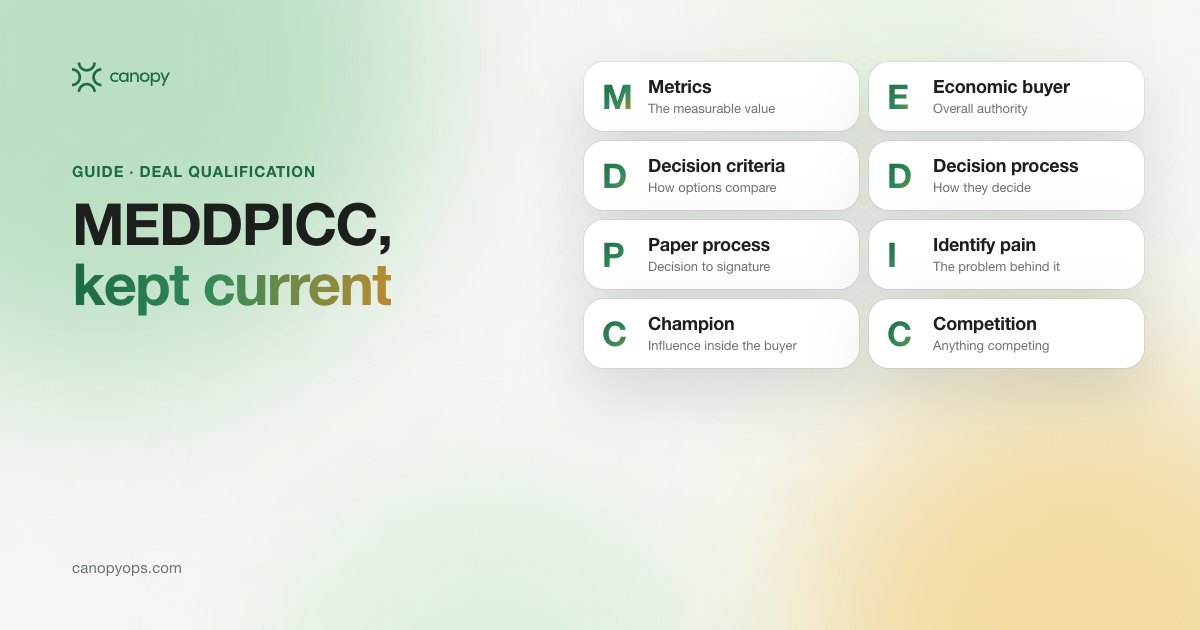
MEDDPICC gives B2B sales teams eight things to confirm on a deal: Metrics, Economic buyer, Decision criteria, Decision process, Paper process, Identify (or Implicate) pain, Champion and Competition. The framework grew out of MEDDIC, which started at PTC in the mid-1990s. Teams keep it current by updating one CRM field per letter after each call, with evidence.
Key takeaways on MEDDPICC
- MEDDPICC is a deal qualification framework with eight elements, and each one should rest on something the buyer said or did.
- MEDDIC came first with six elements; MEDDICC added Competition, and MEDDPICC added Paper process, the steps from a decision to a signature.
- Sources disagree on who created MEDDIC: the training company MEDDICC credits Dick Dunkel at PTC, while HubSpot's lead qualification guide credits Jack Napoli.
- MEDDPICC fits multi-stakeholder deals with legal and procurement steps, and it is too heavy for short, single-buyer sales.
- The framework only works in the CRM when each field has an owner, an update moment tied to a specific call, and a place in the weekly pipeline review.
What does MEDDPICC stand for?
MEDDPICC stands for Metrics, Economic buyer, Decision criteria, Decision process, Paper process, Identify pain, Champion and Competition. Some teams read the I as "Implicate the pain", which asks the rep to tie the problem to its business consequence. Each letter names a fact the seller needs before a deal belongs in a forecast. Together, the eight letters cover why the buyer would spend money at all, who decides, how they decide, and what could stop the deal or send it elsewhere. Sales teams apply the framework to opportunities, after a first meeting has happened. Raw leads need a lighter check. A deal with all eight letters confirmed has a named buyer and a mapped path to signature.
MEDDPICC letter by letter: meaning, the rep's question and the evidence
The table gives each MEDDPICC letter with a plain definition, a question a rep can ask on a call, and the evidence to log before the letter counts as confirmed. Definitions for Metrics, Economic buyer, Decision process, Paper process, Champion and Competition paraphrase the ones published by MEDDICC on its MEDDPICC page.
| Letter | What it means | The question a rep asks | Evidence that counts |
|---|---|---|---|
| M: Metrics | The quantifiable measures of value the solution provides to the buyer | What number has to move for this to be worth it, and by when? | A figure the buyer stated, with a baseline and a target |
| E: Economic buyer | The person with overall authority in the buying decision | Who signs off on this spend, and when can we meet them? | A named person, a meeting held with them, and their own words on why it matters |
| D: Decision criteria | The standards the buyer will use to compare options, such as technical fit, commercial terms and risk | How will you compare the options, and who wrote those criteria? | A criteria list from the buyer, or criteria the buyer confirmed in writing |
| D: Decision process | The steps the buyer's organization takes to reach a decision | What happens between today and a decision, and who is involved at each step? | A sequence of steps with names and dates the buyer agreed to |
| P: Paper process | The steps from the decision to a signature: legal review, security review, procurement | Once you decide, what has to happen before a contract is signed? | Named legal and procurement contacts, the documents they need, and a signature date |
| I: Identify pain (or Implicate the pain) | The business problem behind the purchase, and what it costs the buyer if nothing changes | What happens to your target if this stays as it is for another year? | The pain in the buyer's words, linked to a cost or a missed goal, and who feels it |
| C: Champion | A person inside the customer with power, influence and credibility who argues for the purchase when the seller is absent | What would you need from me to make the case internally? | Actions, such as sharing internal information or arranging the economic buyer meeting |
| C: Competition | Anything that competes for the same resources as the solution, including another vendor, an internal build or doing nothing | What else is competing for this budget, including leaving things as they are? | The named alternatives and the buyer's view of each |
Why MEDDPICC asks for evidence on every letter
MEDDPICC breaks down when reps fill the fields from memory or optimism. A Champion field holding a name, with nothing that person has done for the deal, tells the manager almost nothing. An Economic buyer field holding a title from the org chart is a guess about authority. The useful test for every letter is whether a colleague could read the field and point to the call, email or document it came from. I'd rather see three letters with real evidence than eight filled in to clear a stage gate, because the forecast is built on what the fields say. Evidence also ages: a champion who went quiet for a month should change the field even if nobody on the buyer's side said anything.
Where MEDDIC came from: PTC, Dick Dunkel, Jack Napoli and John McMahon
MEDDIC, the six-letter parent of MEDDPICC, came out of PTC, the engineering software company, and published accounts credit different people. MEDDICC, a company that sells MEDDPICC training and certification, says on its "Who created MEDDIC?" page (October 2026) that MEDDIC was created in 1996 inside PTC by Dick Dunkel, who worked under senior vice president John McMahon alongside teammate Jack Napoli. The same page says Dunkel and Napoli were first given the job of fixing PTC's sales rep attrition problem. MEDDICC sells training built on the method, so its history is that company's account.
HubSpot's lead qualification guide (Kiran Shahid, updated June 2026) says MEDDIC was developed by Jack Napoli at PTC. Both sources agree on PTC and on the six original elements: Metrics, Economic Buyer, Decision Criteria, Decision Process, Identify Pain and Champion. John McMahon has been chief revenue officer at five public enterprise software companies, PTC among them, along with Geo-Tel, Ariba, BladeLogic and BMC, according to a Force Management interview. MEDDIC, then, was created at PTC in the mid-1990s and is credited to Dick Dunkel and Jack Napoli, working under John McMahon.
Who added Competition and Paper process to MEDDIC?
No public source in this guide's research names who added the extra letters or when. MEDDICC's MEDDPICC page states that MEDDICC added Competition and MEDDPICC added Paper Process, without crediting either change to a person or a year. Quotes online that credit the P to a named executive appear only secondhand, and the original interview could not be found. The record supports the order: MEDDIC with six elements, then MEDDICC with a second C, then MEDDPICC with a P.
MEDDIC vs MEDDICC vs MEDDPICC: what each version adds
MEDDIC, MEDDICC and MEDDPICC share the same core, and each later version adds one element for a harder kind of deal. MEDDICC, the training company, positions MEDDIC for simpler B2B sales with fewer stakeholders, MEDDICC for competitive markets, and MEDDPICC for mid-market and enterprise deals where legal and procurement are involved. That positioning comes from a vendor that teaches all three, so treat it as guidance on fit.
| Framework | Elements | What it adds | Where MEDDICC positions it |
|---|---|---|---|
| MEDDIC | Metrics, Economic buyer, Decision criteria, Decision process, Identify pain, Champion | The original six, created at PTC in the mid-1990s | Simpler B2B sales with fewer stakeholders |
| MEDDICC | The MEDDIC six plus Competition | A second C, for anything competing for the same budget | Competitive markets |
| MEDDPICC | The MEDDICC seven plus Paper process | A P, for the steps from decision to signature | Mid-market and enterprise deals that involve legal and procurement |
Identify pain or Implicate the pain: which I does MEDDPICC use?
MEDDPICC often uses "Implicate the pain" where MEDDIC used "Identify pain", and MEDDICC's own pages follow that split. The change raises the bar. Identifying pain means the rep knows the buyer's problem. Implicating the pain means the buyer has tied that problem to a consequence they care about, such as a missed revenue target or a risk an executive has to answer for. A rep can identify pain on a first call by listening. Implicating it usually takes a second conversation, with numbers, often with someone more senior. Either reading works for field design, as long as the team agrees which standard the I field holds.
When MEDDPICC fits, and when it is too heavy
MEDDPICC fits deals where several people decide, the spend needs executive approval and the contract has to pass legal or procurement. MEDDPICC is too heavy where one person can say yes within a week.
Deals where MEDDPICC earns the time it takes
MEDDPICC pays back on long, multi-threaded B2B deals. Buying groups are large: Forrester's public summary of its 2025 "Buying Groups For The Win" report says that, on average, 13 people within an organization are involved in a buying decision. A rep who knows one of those people well has a contact. MEDDPICC asks for more: who holds the budget, who sets the criteria, who runs the process and who handles the paperwork. Paper process matters most in enterprise and regulated deals, where security reviews, vendor onboarding and redlines add weeks after the buyer says yes. A deal forecast for this quarter with no named procurement contact has a close date nobody has tested.
Signs MEDDPICC is too heavy for your sales motion
MEDDPICC is overkill for transactional sales. If most deals close in under a month through a trial, a card payment or one approver, the paper process is a checkout page and the champion and economic buyer are the same person. Asking reps to fill eight fields on those deals produces guesses, and guesses in CRM fields are worse than blanks because they look like data. MEDDPICC is also the wrong tool at the top of the funnel. An SDR on a sales development team booking a first meeting needs to know whether there is a real problem and a reason to talk now, which is a lighter check. Some teams keep MEDDIC or MEDDICC for mid-size deals and add the P only when a deal crosses a value threshold.
How to keep MEDDPICC current in HubSpot or Salesforce
Keeping MEDDPICC current in the CRM starts with field design. Most teams build it as deal properties in HubSpot or opportunity fields in Salesforce, one set per letter. A practical set has a status pick-list (Unknown, Identified, Validated, At risk), a short evidence note in the buyer's terms, and a "last confirmed" date. Economic buyer and Champion should link to contact records, so the deal shows real people instead of job titles. Status alone hides the evidence and free text alone goes unread, so the pair works better than either. Whoever owns revenue operations usually owns this design, including which statuses each stage requires. Keep stage requirements light: requiring all eight letters at discovery teaches reps to type something in to move the deal.
Who updates which MEDDPICC field, and after which call
Each MEDDPICC field needs one owner and an update moment. The account executive owns almost every letter, the SDR adds a first read on pain at handoff, a solutions engineer adds detail on criteria, and the manager reads without editing. A common cadence:
| Moment in the deal | Who updates | MEDDPICC fields touched | Evidence to log |
|---|---|---|---|
| Meeting booked | SDR | Identify pain (first read) | The trigger and the problem the prospect named |
| Discovery call | Account executive | Metrics, Identify pain, Champion (candidate), Competition | Numbers the buyer gave and who offered to help |
| Economic buyer meeting | Account executive | Economic buyer, Metrics (confirmed), Implicate the pain | The meeting date and what the economic buyer said matters |
| Demo or technical evaluation | Account executive and solutions engineer | Decision criteria, Competition | The buyer's criteria and which alternatives are still in play |
| Proposal and agreed plan | Account executive | Decision process, Champion (tested) | Agreed steps and dates, and whether the champion did what they offered |
| Security, legal and procurement | Account executive, with legal or the deal desk | Paper process | Named contacts, required documents and the target signature date |
| Weekly pipeline review | Sales manager (reads only) | All eight, by exception | Questions for the rep, logged as next steps |
Rules that stop MEDDPICC fields going stale
MEDDPICC fields go stale within weeks unless a few rules hold. Update the fields on the day of the call, while the buyer's wording is fresh, and write the evidence note in the buyer's words, because their phrasing is what the next reader needs. Move a status down as readily as up: a champion who stopped replying goes to At risk, and a slipped procurement date changes Paper process. Report on the "last confirmed" date, so a field validated two months ago shows its age. Keep required fields per stage few. When a deal changes owner, the new rep re-confirms Economic buyer and Champion on their first call before trusting inherited fields.
How the pipeline review uses MEDDPICC
A pipeline review uses MEDDPICC to test the forecast one gap at a time. The manager filters to deals in the quarter's commit and best-case categories and reads the letters by exception, starting with anything below Validated. Questions go to the evidence: "When did you last speak to the economic buyer?" gets a better answer than "Is the EB confirmed?" In my view, three letters predict close-date risk most directly: Economic buyer, Decision process and Paper process. A commit deal with no economic buyer meeting, or with procurement not started, should drop a category or carry a dated plan to close the gap. Across the pipeline, the weakest letter is a coaching signal: if Paper process is Unknown on most late-stage deals, the proposal call needs a procurement question. Track the KPIs to baseline before buying new sales tools, such as win rate and sales cycle length, to see whether tighter qualification changes outcomes.
Where Canopy's Deals workspace fits alongside MEDDPICC
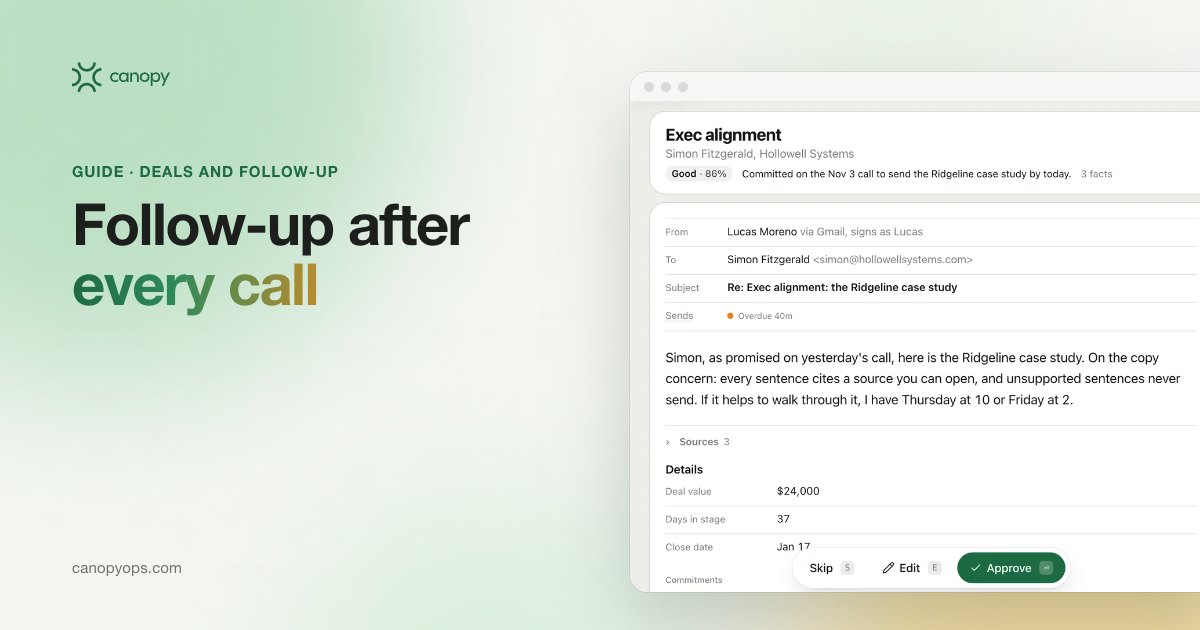
Canopy's Deals workspace reads every call and pulls out a short summary, the commitments made on both sides (who, what, by when, and whether each is open or done), the objections raised and the agreed next steps. Those details sit on the deal in Canopy, beside the drafted follow-up, with the deal's stage, value, days in stage, close date and whether it is slipping. A rep updating MEDDPICC after a call starts from what the buyer agreed to and pushed back on, written down. Canopy doesn't fill, score or write MEDDPICC fields. The rep sets each letter's status and updates the fields in HubSpot, and stages change in the CRM too: the Update stage action opens the deal there. Our guide to AI sales follow-up covers how the follow-up after each call gets drafted.
How Canopy's coaching view shows which discovery areas are missing
Canopy's Coaching view in Deals scores discovery depth: how many of six discovery areas a rep's calls cover, on average. The six are pain, current process, budget, timeline, decision process and success criteria. By definition, three of them map onto MEDDPICC letters: pain to Identify pain, decision process to Decision process, and success criteria to Decision criteria. Budget and timeline map to BANT. The view's recommendation reads "Budget and timeline are the areas most often skipped. Ask them before pricing." Coaching also shows each rep's talk ratio, questions per call, when pricing first comes up, and next-step clarity, the share of calls ending with a named next step, an owner and a date. A manager can see which parts of the picture a rep's calls leave out and take that into the next one-to-one.
What a sales team still owns when an agent reads the calls
A sales team using agents on its calls still owns qualification. An AI sales agent reading a transcript can surface what the buyer committed to and objected to, which is the extraction work AI in sales handles well. Whether a contact is a champion or a polite listener is a judgment about behavior over weeks, and the economic buyer often never joins a call. Canopy doesn't identify the economic buyer, the champion, the competition or the paper process from calls. The account executive makes those judgments and the manager tests them in the pipeline review. The CRM stays the record. Teams weighing how this fits their wider motion can start with Canopy for sales teams.
Common questions about MEDDPICC
What is MEDDPICC in sales?
MEDDPICC is an eight-part framework for qualifying B2B deals: Metrics, Economic buyer, Decision criteria, Decision process, Paper process, Identify (or Implicate) pain, Champion and Competition. The framework descends from MEDDIC, which began at PTC in the mid-1990s. Sales teams keep it useful by giving each letter a CRM field, updating it after the call that produces the evidence, and reviewing the gaps every week.
What is the difference between MEDDIC and MEDDPICC?
MEDDPICC adds two elements to MEDDIC's original six: Competition and Paper process. MEDDIC covers Metrics, Economic buyer, Decision criteria, Decision process, Identify pain and Champion. MEDDICC added a second C for Competition, and MEDDPICC added a P for Paper process, the steps from a decision to a signature. The training company MEDDICC positions MEDDPICC for mid-market and enterprise deals that involve legal and procurement.
Who created the MEDDIC sales methodology?
MEDDIC was created at PTC in the mid-1990s, but sources credit different people. MEDDICC, which sells MEDDPICC training, says Dick Dunkel created it in 1996 while working under John McMahon, with Jack Napoli as a teammate. HubSpot's lead qualification guide credits Jack Napoli. No public source in this guide's research names who later added Competition or Paper process.
What does the P in MEDDPICC stand for?
The P in MEDDPICC stands for Paper process: the steps that follow the buyer's decision and lead to a signed contract. Those steps usually include legal review, security questionnaires, vendor onboarding and procurement approval. A rep confirms Paper process by naming the contacts involved, the documents each one needs and a signature date both sides accept, ideally before the proposal goes out.
Is MEDDPICC better than BANT for lead qualification?
MEDDPICC and BANT do different jobs, so neither is better in general. BANT checks budget, authority, need and timeline, which suits a quick first-call screen. MEDDPICC adds decision criteria, decision process, paper process, a champion and the competition, which suits multi-stakeholder deals after an opportunity exists. Many teams use a light check for leads and MEDDPICC for qualified opportunities.
How do you track MEDDPICC in HubSpot or Salesforce?
Track MEDDPICC with one set of fields per letter on the deal or opportunity: a status pick-list, a short evidence note and a last-confirmed date. Link Economic buyer and Champion to contact records. Require only a few letters at each stage exit, and build a report that lists late-stage deals where any letter sits below Validated, so the weekly pipeline review starts from the gaps.
Who should update MEDDPICC fields, the SDR or the account executive?
The account executive should own MEDDPICC fields, because most of the evidence comes from discovery, evaluation and proposal calls the AE runs. The SDR can log a first read on pain at handoff. A solutions engineer can add detail on decision criteria, and legal or the deal desk can inform Paper process. Managers read the fields in pipeline reviews but should not edit them.
When is MEDDPICC too much for a sales team?
MEDDPICC is too much when deals are small, short and decided by one person. If most deals close within a month through a trial, a card payment or a single approver, the extra letters produce guessed fields rather than insight. Those teams do better with a short qualification check, adding MEDDIC or MEDDPICC only for larger deals that pass a value threshold.
How do managers use MEDDPICC in a pipeline review?
Managers use MEDDPICC in a pipeline review to test whether committed deals can close when forecast. They filter to deals in commit or best case, read each letter by exception, and ask for the evidence behind any field below Validated. Economic buyer, Decision process and Paper process gaps on late-stage deals usually justify moving a deal down a forecast category.
Does Canopy fill in MEDDPICC fields automatically?
No, Canopy doesn't fill, score or write MEDDPICC fields. Canopy's Deals workspace reads each call and pulls out the summary, the commitments on both sides, the objections and the next steps, and keeps them on the deal in Canopy. Its coaching view shows how many of six discovery areas each rep's calls cover. The rep updates the qualification fields in the CRM.
Written by John Miraglia, Co-Founder of Canopy, who leads product and platform. John built and exited a B2B SaaS company by automating every step of the pipeline instead of hiring more reps. Last updated: November 2026.
Canopy is opening its agentic revenue system to a small group of companies first. If your team qualifies deals with MEDDPICC and wants the evidence from every call on the deal, apply to become a launch partner.
Deals
See how Canopy puts this to work on top of HubSpot, with your team approving what sends.