A sales follow-up email is the message a rep sends when a deal moves or goes quiet: after a first meeting, a demo, a no-show, a stalled stretch, a pricing call, a verbal yes or a loss. This guide gives seven templates, one per stage, each with when to send it, a short email to copy and why it works.
Key takeaways on sales follow-up emails
- A sales follow-up email on an active deal works best when it opens on what the rep promised, answers what the buyer raised and asks for one next step with two specific times.
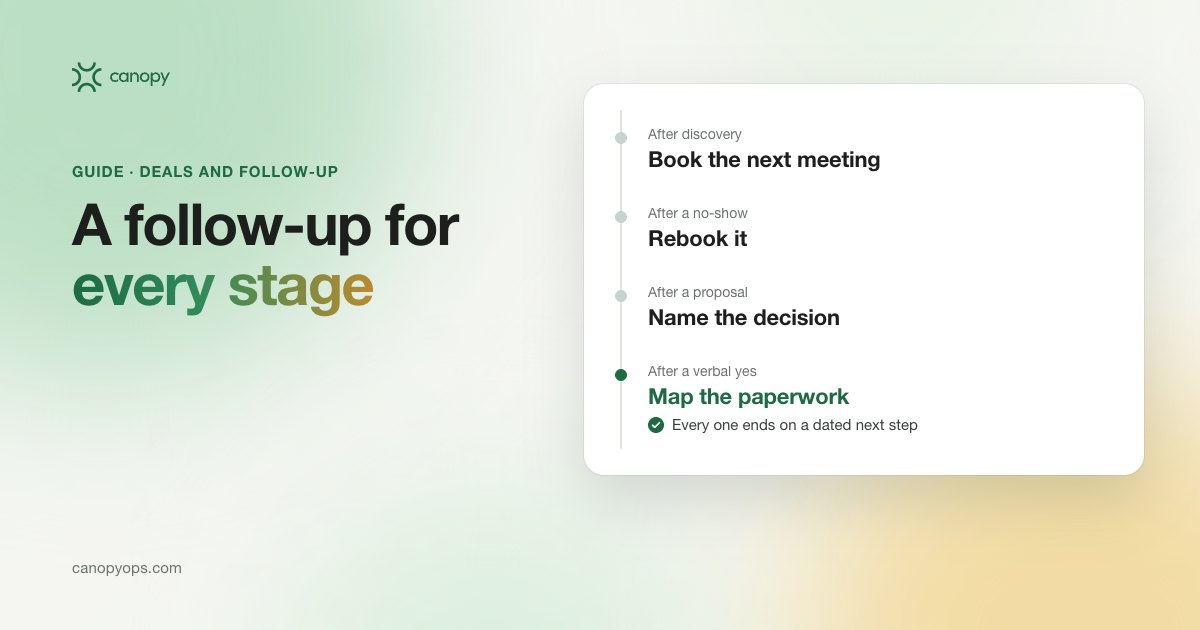
- Each deal stage needs a different follow-up, because the goal changes: book the next meeting after discovery, rebook after a no-show, name the decision after a proposal and map the paperwork after a verbal yes.
- Ebsta's 2024 benchmarks found top performers were 412% more likely to have a next step or meeting defined, so every template here ends on a dated next step.
- The popular claim that 80% of sales need five or more follow-ups has no traceable source, and this guide does not use it.
- Canopy's Deals workspace drafts each follow-up from the call itself for the rep to approve, timed to the day the rep's commitment comes due.
What every sales follow-up email needs, at any stage
Every template in this guide is built from four parts. The opening line keeps a promise, such as the pricing you said you'd send or the answer you owed. Next comes the buyer's open question or objection, answered in their words, since that question is the one they will repeat to whoever signs off. Then one next step, with two specific times, so the reply can be a single yes. The fourth part is length. A follow-up should be short enough to read on a phone between meetings, which in practice means five or six lines.
Follow-ups slip because they compete with everything else on a rep's list. Salesforce's 2026 State of Sales survey of 4,050 sales professionals found the average seller spends 40% of their time selling. Salesforce sells AI agents, so read that as a vendor survey. A template shortens the writing. The timing still depends on someone remembering the date the buyer gave, the problem Canopy for sales teams is built around.
Sales follow-up email templates by deal stage at a glance
Seven moments in a B2B deal call for a follow-up email, and each has a different job. The table maps each stage to the event that triggers the email, the goal of the email and a send time drawn from common practice. No public study sets these times, so adjust them to how fast your buyers usually answer.
| Deal stage | Trigger | Goal of the email | When to send |
|---|---|---|---|
| First meeting | The discovery call ends | Confirm what you heard and lock in the next meeting | Same day |
| Demo | The demo ends with an open question | Answer the objection and book the next step | Same day or next morning |
| No-show | The buyer misses a booked meeting | Rebook with as little effort for the buyer as possible | Within the hour |
| Gone quiet | The deal runs past its stage's usual length with no reply | Get a new date, a yes or a clear no | When the stage runs long |
| Pricing or proposal | Pricing was discussed or the proposal went out | Name the decision, who makes it and by when | Within a day |
| Verbal yes | The buyer says yes before anything is signed | Map every step left before signature | Same day |
| Loss | The buyer picks another option or no option | Learn the real reason and leave a door open | Within a few days |
Follow-up emails after a first meeting or a demo
Sales follow-up email template after a first meeting
The first-meeting follow-up goes out the same day as the discovery call, while the buyer still remembers what they told you.
Subject: [Company] and [your company]: notes from [day]
Hi [first name],
Thanks for the time today. My notes, so you can correct anything I got wrong: [the problem in their words], [what it costs them now] and [what has to be true to fix it this quarter].
I said I'd send [the thing you promised]. Here it is: [link].
Next step we agreed: [meeting] with [who] on [date]. The invite is in your calendar. If [date] no longer works, [time option 1] or [time option 2] are open on my side.
[Your name]
The first-meeting recap works because it ends on a next step with a date, an owner and a fallback. Ebsta's 2024 B2B Sales Benchmarks, built with Pavilion on 4.2 million opportunities across 530 companies, found top performers were 412% more likely to have a next step or meeting defined. Ebsta sells sales analytics and the figure is relative, but the habit costs one line.
Follow-up email template after a product demo
The demo follow-up goes out the same day or first thing next morning, once you have the answer to the question you couldn't fully answer live.
Subject: Your question about [objection topic]
Hi [first name],
On [day]'s demo, [name] asked whether [objection in their words]. Short answer: [direct answer]. Here's where you can see it for yourself: [doc page, spec or screenshot].
You also wanted to see [feature they asked about] with your own [data or process]. I can walk [name] through that in 20 minutes. Would [time option 1] or [time option 2] work?
[Your name]
The demo follow-up works because it skips the feature recap the buyer already sat through and goes straight to the objection. Whoever raised that objection on the call will raise it again in the internal meeting you aren't invited to, so give them a written answer they can forward. Offering two specific times cuts the scheduling back-and-forth to one reply.
Follow-up emails when the buyer goes quiet
Follow-up email after a no-show
The no-show follow-up goes out within the hour of the missed slot, with no hint of complaint.
Subject: Missed you at [time]
Hi [first name],
I had us down for [time] today and didn't see you on the call. Easy to happen in a busy week.
You booked the time to talk about [the reason from their form or last email]. I have [time option 1] or [time option 2] free, or you can pick any slot here: [booking link].
[Your name]
The no-show email works because many companies never send one. RevenueHero's 2024 test of 1,000 B2B SaaS websites found only 61% of companies that used a scheduler followed up when the booked meeting was a no-show. RevenueHero sells scheduling software, so treat the test as vendor research. Naming the reason the buyer booked reminds them why the meeting mattered to them, and the booking link removes the last excuse. The same speed matters before the first meeting too, as covered in how agents answer inbound leads in minutes.
Follow-up email when a deal goes quiet
The quiet-deal follow-up goes out when a deal has sat longer than its stage usually takes, with no reply and no meeting booked.
Subject: [Project name]: still aiming for [their date]?
Hi [first name],
When we spoke on [date], you were aiming to [their goal] by [their deadline]. Is that still the plan?
If it is, the next step is [one concrete step], and [time option 1] or [time option 2] would keep you on track. If priorities have moved, a one-line reply saying so helps me too, and I'll stop chasing.
[Your name]
The quiet-deal email works because it ties the follow-up to the buyer's own deadline and makes "no" an acceptable answer. Slipped deals are common and costly: Ebsta's 2025 GTM Benchmarks digest found 36% of deals slipped, and the more deals slip, the lower the win rate. A "just checking in" email gives the buyer nothing to answer. A dated question gets an answer you can forecast on, even when that answer is no.
Follow-up emails late in the deal
Follow-up email after a pricing or proposal call
The proposal follow-up goes out within a day of the pricing conversation, with the proposal attached or linked.
Subject: [Company] proposal and your question on [topic]
Hi [first name],
As promised on [day]'s call, here's the proposal: [link]. It covers [the scope you agreed] on [the option you discussed].
You asked about [pricing objection in their words]. [Your answer: the trade-off, a phased option, or the return worked out from their own numbers].
To have this signed by [their target date], [decision maker] would need to review it by [date]. Can we hold [time option 1] or [time option 2] to go through it together?
[Your name]
The proposal follow-up works because it names the decision, the person who makes it and the date it needs to happen. Deals often die undecided: in Ebsta's 2024 benchmarks, reps attributed 61% of lost deals to "indecision". A proposal that arrives with no date and no review meeting leaves the buyer to schedule the decision on their own, and many never do. Opening on the promise ("as promised on Tuesday's call") also shows the buyer you do what you say.
Follow-up email after a verbal yes
The verbal-yes follow-up goes out the same day the buyer says yes, before the energy of the decision fades.
Subject: Next steps to get [Company] live by [start date]
Hi [first name],
Thanks for the yes on [day]. Here's what happens between now and [start date], so nothing waits on either of us.
[Contract] goes to [legal contact] on [date]. [Security review or vendor setup] goes to [procurement contact] on [date]. Your kickoff with [onboarding lead] is booked for [date].
Is anyone who needs to sign off missing from that list? Tell me who, and I'll get them what they need this week.
[Your name]
The verbal-yes email works because the weeks between a yes on a call and a signature are where paperwork stalls. Listing every remaining step with an owner and a date makes the gaps visible: the legal contact nobody briefed, the security questionnaire sitting in procurement. Asking who is missing finds the late approver while there is still time to brief them. Keep the tone plain. A buyer who has just said yes does not need persuading again.
Follow-up email after a lost deal
The loss follow-up goes out within a few days of the buyer's decision, once you have taken the news without arguing it.
Subject: Thanks, and one question
Hi [first name],
Thanks for telling me directly. I'd rather hear it than be left guessing.
One question, if you have a minute: what decided it? A one-line reply is plenty.
If [their stated reason] changes, or [the option they chose] doesn't work out, I'm easy to find. I'll check in around [their next planning or renewal date].
[Your name]
The loss email works because it asks for the reason in the buyer's words. Reps' own loss notes are often vague: in Ebsta's 2024 benchmarks, reps put 61% of lost deals down to "indecision". A real reason, even a short one, tells you whether to fix the pitch or the qualification. Naming a check-in date also gives you a reason to come back that the buyer has already accepted. In Canopy, closed-lost deals leave the active pipeline and move to the Lifecycle workspace for recovery.
How long to wait between sales follow-up emails
No public study sets the right gap between follow-ups on an active deal, so the timings in this guide come from practice. Email reply data points one way. A Yahoo Labs study of 16 billion emails, published by Kooti and colleagues in 2015, found more than 90% of replies happen within a day and half arrive within 47 minutes. That research covers everyday email between people, and sales email may behave differently. The finding still supports a working rule: if a buyer who normally answers within hours has said nothing for two or three days, your email was probably missed or pushed down the list.
Follow up then, and add something new each time, such as an answer or a firmer date. On how many follow-ups to send, the closest public data comes from outreach to strangers. Backlinko's 2019 analysis of 12 million outreach emails, using Pitchbox data, found one additional follow-up boosted replies by 65.8%. Those were link-building emails, so the figure supports sending a second message and says little about deals already in motion. On an active deal, I change the ask after two unanswered follow-ups: a different contact, or a direct question about whether the project is still alive.
Sales follow-up statistics you can trace to a source
Most sales follow-up statistics online have no source a reader can open. The best known, that 80% of sales are made on the fifth to twelfth contact, travels with a second claim that 48% of salespeople never follow up. Both trace to a "National Sales Executive Association" that VentureBeat could find no record of in 2014. This guide leaves both out. Each figure in the table below comes from a public page anyone can open, and most of the figures are vendor data, labeled as such. The most useful number for your team is still your own: measure follow-up speed and next-step coverage against the KPIs to baseline before buying tools.
| Statistic | Source and year | What it covers |
|---|---|---|
| Top performers were 412% more likely to have a next step or meeting defined | Ebsta with Pavilion, 2024 | 4.2 million opportunities at 530 companies; vendor data, relative figure |
| Reps attributed 61% of lost deals to "indecision" | Ebsta with Pavilion, 2024 | Same dataset; loss reasons as reported by reps |
| 36% of deals slipped, and more slippage meant a lower win rate | Ebsta with Pavilion, 2025 | Sales efficiency benchmark digest; vendor data |
| Only 61% of companies using a scheduler followed up after a no-show | RevenueHero, 2024 | Test of 1,000 B2B SaaS websites; vendor test |
| The average seller spends 40% of their time selling | Salesforce State of Sales, 2026 | Survey of 4,050 sales professionals; vendor survey |
| More than 90% of email replies arrive within a day; the median is 47 minutes | Kooti et al. (Yahoo Labs), 2015 | 16 billion everyday emails, not sales email |
| One additional follow-up boosted replies by 65.8% | Backlinko with Pitchbox data, 2019 | 12 million link-building outreach emails |
How Canopy's Deals workspace writes each follow-up from the call
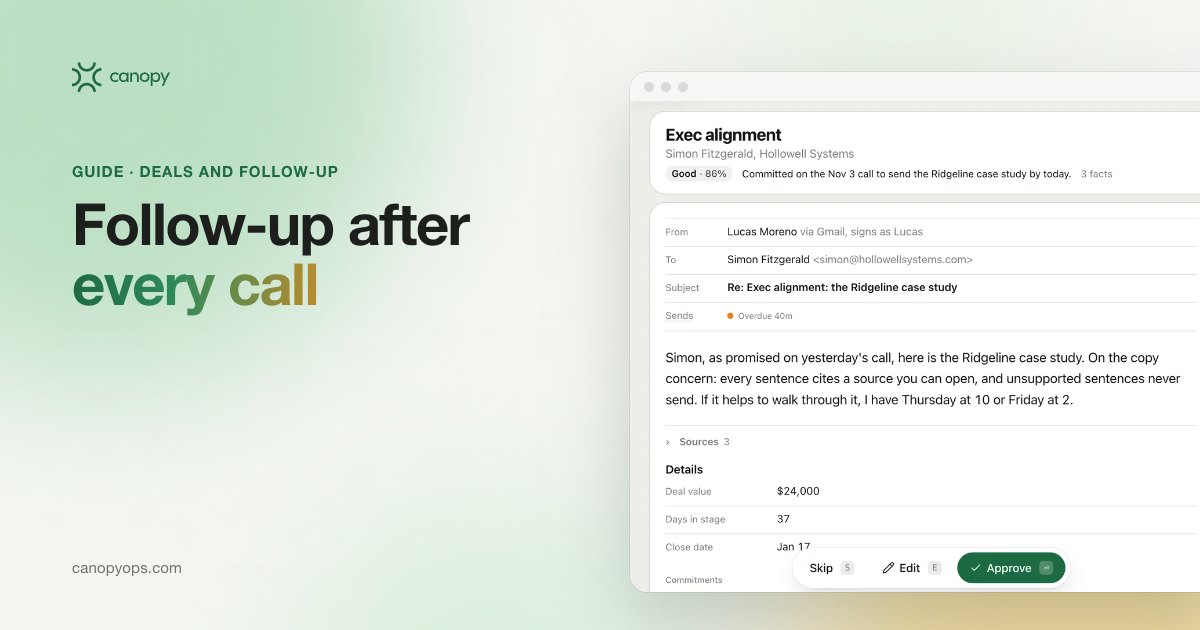
Templates give a rep a starting shape. Canopy's Deals workspace starts from the call instead. Deals extracts the commitments, objections and next steps from your call recordings, then queues a follow-up for the day the rep's commitment comes due. The draft opens on the promise ("as promised on yesterday's call, here is the pricing"), answers the objection the buyer raised on that call and offers two times to talk. Every sentence links to the call or the CRM record behind it, so the rep can check any line before sending. Each draft also carries a recommended send time, set before the commitment's deadline, with the reason.
Canopy sends the follow-up from the rep's own mailbox, in the rep's name. Deals is locked to Approve to send, one of the approval controls in Agent Control: the rep reads, edits and approves every follow-up, and a 30-second undo follows each approval. Deals Today opens on the follow-ups due that day, each with its reason, such as "Committed on the [date] call to send the pricing by today". The guide to AI sales follow-up covers how an agent gets from a call to a draft, and the Canopy Deals platform page shows the workspace.
How Canopy handles a deal that goes quiet
Canopy flags a deal as stalled when it passes its stage's threshold with no meeting booked and nothing due. The thresholds in Deals are 10 days in Discovery, 14 in Evaluation, 18 in Proposal, 14 in Negotiation and 10 at Verbal yes. Once a deal crosses one, Deals drafts a short nudge in the owner's voice from the last call, with one concrete ask and two time slots, and the rep approves it like any other follow-up. The queue keeps these Stalled items apart from the day's Follow-ups. Closed-lost deals leave Deals entirely, since the workspace covers the active pipeline only.
Sales follow-up email questions buyers ask
What is a sales follow-up email?
A sales follow-up email is the message a rep sends after a deal moves or stalls, such as after a first meeting, a demo, a missed meeting, a pricing call, a verbal yes or a loss. Each stage needs a different email. The strongest ones open on a promise kept, answer the buyer's open question and ask for one dated next step with two specific times to choose from.
How soon should I send a follow-up email after a sales meeting?
Send the follow-up the same day as the meeting, while the buyer still remembers the conversation. No public study measures the best timing for a post-meeting recap, so treat this as common practice. Everyday email data from Yahoo Labs (2015) shows more than 90% of replies happen within a day, which suggests a same-day recap arrives while the thread is still active.
How many follow-up emails should I send before giving up on a deal?
Send two follow-ups on the same ask, then change the ask. Try a different contact, a smaller next step or a direct question about whether the project is still alive. No public study sets a number for active deals. Backlinko's 2019 analysis of 12 million link-building emails found one extra follow-up boosted replies by 65.8%, which supports a second message but not an endless sequence.
Is it true that 80% of sales need five or more follow-ups?
No traceable source supports that claim. The figure, usually stated as 80% of sales being made on the fifth to twelfth contact, is credited to a "National Sales Executive Association" that VentureBeat could find no record of in 2014. The companion claim that 48% of salespeople never follow up comes from the same untraceable source. Neither figure belongs in a sales deck or a forecast.
What should the subject line of a sales follow-up email say?
The subject line should name the specific thing inside the email: the buyer's question, their project or the date they gave. "Your question about [topic]" or "[Company] proposal and your question on [topic]" tells the buyer what they are opening. Vague lines such as "Checking in" or "Following up" give them no reason to open the email before anything else in their inbox.
How do I follow up when a prospect misses a booked meeting?
Send a short, friendly rebook email within the hour, with two new times and a booking link. Name the reason they booked so the value is back in front of them. RevenueHero's 2024 test of 1,000 B2B SaaS websites found only 61% of companies that used a scheduler followed up after a no-show, so a plain rebook already puts you ahead of many sellers.
How do I follow up after sending a proposal?
Follow up within a day with the proposal linked, an answer to the pricing question the buyer raised and a request for a review meeting with the decision maker by a named date. Ebsta's 2024 benchmarks found reps attributed 61% of lost deals to indecision, and a proposal with no decision date invites exactly that. Two specific times for the review make the next step easy to accept.
Should I send a follow-up email after losing a deal?
Yes, send one short email within a few days that thanks the buyer, asks what decided it and names a date you will check back. The buyer's own reason is better data than a rep's guess, and a check-in date the buyer has already seen makes a later message welcome. In Canopy, closed-lost deals move to the Lifecycle workspace, where lifecycle marketing takes over recovery.
Can AI write sales follow-up emails for my reps?
AI can draft sales follow-up emails from call notes, and reps expect it to save time: Salesforce's 2026 State of Sales survey found sellers expect fully deployed agents to cut email drafting time by 36%. That figure is an expectation from a vendor that sells agents. The draft still needs a rep to check it, because the rep made the promises on the call and owns the relationship. The guide to AI sales agents covers the wider category.
Does Canopy send deal follow-ups without the rep's approval?
No, Canopy's Deals workspace is locked to Approve to send. The rep reads, edits and approves every follow-up before it goes, and each approval has a 30-second undo. The email goes from the rep's own mailbox in the rep's name. Canopy queues each follow-up for the day the rep's commitment is due, so the draft is waiting when the promise is.
Are these templates meant for cold emails?
No, these templates are for deals already in motion, where the buyer knows the rep and has usually asked for something. Cold email follow-up goes to people who have never spoken to you and needs different timing and a different ask. Canopy handles that work in its Outbound workspace, where each email in a sequence is drafted and cited, and any reply pauses that account's sequence.
Written by Jon Farrar, Co-Founder of Canopy, who leads lifecycle and go-to-market. Jon was previously head of marketing for an eight-figure global direct-to-consumer brand. Last updated: November 2026.
Canopy is opening its agentic revenue system to a small group of companies first. If promises made on your sales calls keep turning into follow-ups nobody sends, apply to become a launch partner.
Deals
See how Canopy puts this to work on top of HubSpot, with your team approving what sends.