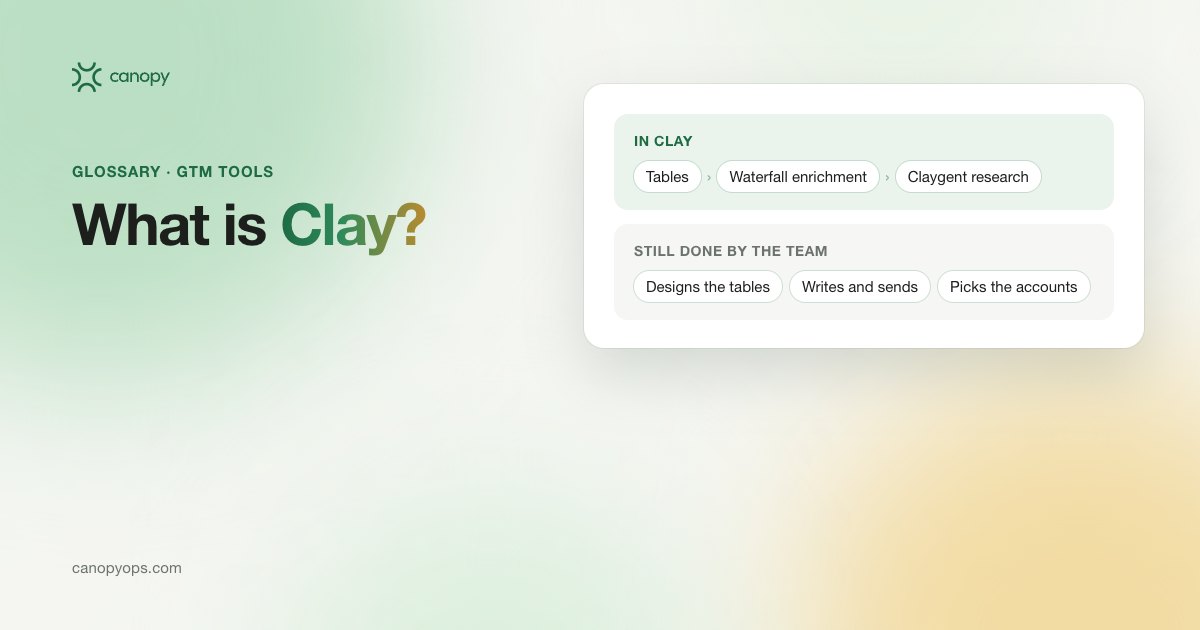
Clay is a go-to-market data platform from Clay Labs Inc., founded in Brooklyn in 2017. GTM teams use Clay to build tables of target companies and contacts, fill them through waterfall enrichment across more than 150 databases, research accounts with its AI agent, Claygent, and send the results to a CRM, sequencer or ad audience.
Key takeaways on what Clay is and how teams use it
- Clay describes itself as infrastructure "to get any data, run agentic workflows, and launch GTM plays," and its core workspace is a spreadsheet-style table that someone has to design, wire up and maintain, a job Clay itself calls GTM engineering.
- Waterfall enrichment across more than 150 databases (Clay's figure) and Claygent, Clay's AI agent with web research, fill the table with data, but the team still writes every Claygent instruction and spot-checks the answers before they reach a message.
- Clay's pricing keeps CRM, warehouse and HTTP API integrations off the Free and Launch plans as of 4 November 2026, so a team that wants enriched rows written back to HubSpot or Salesforce has to move up to Growth or Enterprise.
- Clay raised a $115 million Series D at a $7.1 billion valuation in September 2026, led by Wellington, according to Clay's Series D announcement (2026).
- Canopy, the agentic revenue system, suits teams that want researched, verified outbound without hiring a GTM engineer or climbing Clay's plans: Canopy's Outbound workspace is built and run for you, with a source and a retrieval date on every fact and every send approved until you choose otherwise.
What Clay is, in Clay's own words
Clay calls itself infrastructure "to get any data, run agentic workflows, and launch GTM plays," and the title of Clay's homepage (2026) reads "Clay | Build systems to grow revenue." In day-to-day use, Clay sits between the places a revenue team stores its data and the places it acts on that data. Target accounts come in, Clay adds facts from outside data sources and its own AI research, and finished rows go out to a CRM, a sequencer or an ad platform.
An independent description comes from BetaKit (September 2026), which says Clay "develops and sells AI software and agents designed to help other firms" automate marketing, sales and other GTM tasks. Clay's stated goal today is to give every company the tools to build its own revenue system, so the product now carries agents, workflows and a sequencer alongside the original tables.
Who founded Clay, and how big is the company?
Clay's founding story in Brooklyn
Clay began in Brooklyn in 2017 as a spreadsheet that let anyone connect information and automate work without writing code, according to Clay's About page (2026). The Next Web (September 2026) names Kareem Amin and Nicolae Rusan as the founders and reports that Varun Anand joined in 2021 as a third co-founder. BetaKit adds that Rusan has since left the company, and Kareem Amin is CEO. Clay says salespeople and growth teams began using the product to find and reach customers, and it then focused on them.
Clay's funding, valuation and revenue figures
Clay's valuation more than doubled between August 2025 and September 2026. The September 2026 Series D raised $115 million at $7.1 billion, led by Wellington. The round before was a $100 million Series C in August 2025 at a $3.1 billion valuation, and The Next Web reports that an employee tender offer in January 2026 valued Clay at $5 billion.
Clay's revenue and customer numbers are Clay's own figures. Clay announced in a December 2025 blog post that it had crossed $100 million in annual recurring revenue, two years after reaching $1 million, and says the Series D followed 4x revenue growth in 2025. Clay also says more than 17,000 customers use it, including 80% of the Forbes AI50. BetaKit reports the same 17,000 figure, up from 10,000 a year earlier.
How Clay works: tables, enrichment, Claygent and integrations
What is a Clay table?
A Clay table is the product's main workspace: a spreadsheet where each row is a company or a person and each column holds one piece of data about that row. Clay started as that kind of spreadsheet in 2017. A table usually starts from a list, imported from a CRM or found through Clay's own search. Columns then get added one at a time. Some hold enrichments, some hold AI research answers, and others hold formulas and filters that score or narrow the list before anything leaves Clay.
How Clay enrichment and waterfalls work
Clay enrichment adds data to each row of a table from outside sources, such as a work email, a phone number or company details. Clay builds enrichment around waterfalls. A waterfall combines several data providers for the same field instead of relying on one contact database, so when one provider has no answer for a row, another can fill it. Clay says waterfall enrichment gives access to "150+ databases" on its waterfall enrichment page (2026), and multi-provider waterfalls are included on every Clay plan, Free included. Clay frames the benefit as coverage: a waterfall gives each row more chances to get a value than a single provider would.
What is Claygent?
Claygent is Clay's AI agent with web research. Clay says Claygents take inputs, follow written instructions and write a structured output, per Clay's Claygent page (2026). In a table, that means a question such as "Is this company hiring for sales roles?" can run across every row, with each answer landing in its own column. Clay offers general purpose Claygents that run in Tables and Workflows, and Account Agents that run in Audiences and Workflows. Teams use Claygent for the research a rep would otherwise do by hand before writing to an account.
Clay integrations with CRMs and data warehouses
Clay connects to the systems on either side of a table. The Clay integrations page includes HubSpot and Salesforce, and Clay lists native data warehouse integrations with Snowflake, Fivetran, Postgres, Databricks and BigQuery, plus HTTP API integrations for other tools. On Clay's pricing comparison as of 4 November 2026, CRM integrations, HTTP API integrations and warehouse connections are not included on Free or Launch and are included on Growth and Enterprise. Clay's homepage examples show what the connections are for: keeping CRM records refreshed, routing enriched leads to the right rep, and syncing CRM accounts into LinkedIn, Meta and Google Ads campaigns.
What GTM teams use Clay for
Clay lists nine use cases on its own site: automated inbound, account research, ABM, PLG assist, rep assist, reverse ETL, outbound, CRM enrichment and TAM sourcing.
- Outbound teams build a target list, enrich it, research each account with Claygent and pass the rows to a sequencer.
- Inbound teams enrich, score and route every new lead to the right rep, an example Clay gives on its homepage.
- RevOps teams run CRM enrichment to keep account and contact records current.
- Marketing teams sync CRM accounts into LinkedIn, Meta and Google Ads audiences for account-based campaigns.
- TAM sourcing builds the full list of companies that fit the ideal customer profile.
Most Clay use cases feed something downstream. An outbound list in Clay becomes useful once a person or an AI SDR writes to the accounts on it.
Who uses Clay? The GTM engineer
The user most associated with Clay is the GTM engineer. Clay says it coined GTM engineering as a career in 2023 and that the role has grown in prevalence by 23x since, both Clay's own claims. In an April 2026 post, Clay defines GTM engineering as "the practice of building automated revenue systems using AI, data enrichment, and workflow automation." Alongside the Series D, Clay announced a $1 million scholarship fund to train GTM engineers.
A GTM engineer's work in Clay is building: designing tables, writing Claygent instructions, wiring integrations and fixing workflows when a field or a source changes. The GTM engineer role overlaps with revenue operations, with more building and less reporting, a shift covered in why traditional RevOps is giving way to GTM engineering.
How AI agents are changing the way teams use Clay
Clay is adding agents on top of its tables. Clay says it shipped 12 new products in summer 2026, according to a Clay blog post (September 2026). The largest were Audiences, a data layer for first and third party GTM data, along with Account Agents, Workflows, Sequencer on Audiences and the Clay Plugin, a CLI and API for building in Clay from coding agents. Clay's Series D post describes the direction in one line: "GTM engineers run growth agents the same way software engineers run coding agents." For a Clay user, more of the work becomes writing instructions for agents and checking what they return. The wider category of agents that research accounts and draft outreach is covered in the guide to AI sales agents.
What Clay does well and what a team still does itself
Clay covers the data and research layer of go-to-market work well, and stops there. A team running Clay still supplies the people, the plan, the messages and the judgment about who to contact. The real cost of Clay is larger than the subscription. Someone has to design every table, write every Claygent instruction, wire every integration and fix workflows when a field or a source changes. Clay's own answer to that workload is a new job title, the GTM engineer, which tells a buyer how much building the product expects. A team without that person gets a set of parts to assemble before any outreach goes out. The table below sets out what Clay provides in each area and what the team is left to do itself.
| Area | What Clay provides | What the team still does |
|---|---|---|
| Data coverage | Multi-provider waterfalls on every plan, across more than 150 databases (Clay's figure) | Picks the fields that matter and decides when a record is good enough to use |
| Account research | Claygent web research that writes structured answers into each row | Writes the instructions and spot-checks the answers before they reach a message |
| Staffing and upkeep | Unlimited seats and tables on every plan, plus Workflows and Audiences | Staffs the work, often with a GTM engineer, and builds and maintains each table |
| CRM and warehouse sync | CRM, warehouse and HTTP API integrations on Growth and Enterprise | Decides what writes back to the CRM and keeps those records clean |
| Sending | Sequencer on Audiences, plus audience sync to LinkedIn, Meta and Google | Writes the copy, sets the cadence, reviews what goes out and answers replies |
| Judgment | Lead scoring and routing, and Signals for job changes, promotions and news | Sets the ideal customer profile and decides which signals justify outreach |
Clay plans and pricing
Clay's pricing keeps the features most teams need to act on their data behind the upper plans. Clay lists four plans on Clay's pricing page as of 4 November 2026: Free, Launch, Growth and Enterprise. Every Clay plan, Free included, has unlimited seats and tables. The Free plan runs up to 200 rows per table, which suits a test table more than a full target list, and Clay's FAQ says Launch allows up to 50,000 rows per table. Neither Free nor Launch includes CRM integrations, HTTP API integrations or warehouse connections, per Clay's pricing comparison on the same date. A team that wants enriched rows to write back to HubSpot or Salesforce has to move up to Growth or Enterprise. Unlimited seats help less than they sound, because each seat still needs someone who can build and maintain the tables.
Researched, verified outbound without running the tooling yourself
Some revenue teams want the output of list building and account research without hiring a GTM engineer, building tables or moving up Clay's plans to reach CRM sync. Canopy, the agentic revenue system, is built for that case: AI agents that work your revenue, built and run for you. In Canopy's Outbound workspace, agents research every account, with a source and a retrieval date on every fact, and facts older than 30 days are not used in copy. Contact data is verified, and every address is checked before enrollment. Before any research starts, every list is screened against your CRM for current customers, open opportunities, a do-not-contact list, competitor domains, unsubscribes and anyone emailed in the last 45 days. GTM Engineers set the ICP, the signals and the exclusion rules, as part of how a Canopy deployment runs, and every send is approved until you choose otherwise.
Frequently asked questions about Clay
What does Clay do for GTM teams?
Clay gives GTM teams one place to build lists of companies and contacts, enrich them from more than 150 databases through waterfall enrichment, and research each account with its AI agent, Claygent. The finished rows then sync to a CRM, a sequencer or an ad audience. Clay Labs Inc. started the product in Brooklyn in 2017.
Is Clay a CRM?
Clay is a data and research layer that sits next to a CRM. The Clay integrations page lists HubSpot and Salesforce, and as of 4 November 2026 CRM integrations are included on the Growth and Enterprise plans and not on Free or Launch. Teams usually keep the CRM as the record of truth and use Clay to fill and refresh it.
What is Clay enrichment?
Clay enrichment is the process of adding data, such as a work email, a phone number or company details, to each row of a Clay table from outside sources. Clay's method is waterfall enrichment, which combines multiple data providers instead of relying on one contact database. Clay says its waterfalls reach more than 150 databases, and multi-provider waterfalls are included on every plan.
What is Claygent in Clay?
Claygent is Clay's AI agent with web research. A Claygent takes inputs from a table, follows written instructions and writes a structured answer, so a question such as whether a company is hiring for sales roles can run across every row. Clay also offers Account Agents, which run in Audiences and Workflows.
Who founded Clay and who runs it now?
Kareem Amin and Nicolae Rusan founded Clay in 2017, according to The Next Web, and Clay says it began in Brooklyn. Varun Anand joined in 2021 as a third co-founder, and BetaKit reports that Rusan has since left the company. Kareem Amin is Clay's CEO.
How much is Clay worth?
Clay was valued at $7.1 billion in September 2026, when it raised a $115 million Series D led by Wellington. The valuation was $3.1 billion at its $100 million Series C in August 2025, and an employee tender offer in January 2026 valued Clay at $5 billion, as reported by The Next Web.
How many customers does Clay have?
Clay says more than 17,000 customers use it, including 80% of the Forbes AI50, a figure from its September 2026 Series D announcement. BetaKit reports the 17,000 figure as up from 10,000 a year earlier. Clay's homepage separately says it is trusted by more than 500,000 GTM teams, which is not a customer count.
Is Clay free to use?
Clay has a Free plan, listed on Clay's pricing page as of 4 November 2026. The Free plan includes unlimited seats and tables, multi-provider waterfalls and up to 200 rows per table. CRM, warehouse and HTTP API integrations begin on the Growth plan, and Clay's paid plans are Launch, Growth and Enterprise.
What is a Clay GTM engineer?
A Clay GTM engineer is the person who builds and runs a company's Clay tables, enrichments, Claygent instructions and integrations. Clay says it coined GTM engineering as a career in 2023 and defines the practice as building automated revenue systems using AI, data enrichment and workflow automation. In 2026 Clay announced a $1 million scholarship fund to train GTM engineers.
Do you need a GTM engineer to use Clay?
A team can start in Clay without a dedicated GTM engineer. A salesperson or growth marketer can build a table on the Free plan, and Clay says salespeople and growth teams were among its first users. As tables, Claygent instructions and CRM syncs multiply, someone has to own the system, and Clay calls that job GTM engineering.
Can Clay send emails?
Clay can handle outbound sending through Sequencer on Audiences, one of the products Clay shipped in summer 2026, and Clay tables can also pass enriched rows to an external sequencer. Clay lists outbound among its use cases. A team sending through Clay still writes the copy, sets the cadence and answers the replies.
Written by John Miraglia, Co-Founder of Canopy, product and platform. John built and exited a B2B SaaS company by automating every step of the pipeline instead of hiring more reps. Last updated: November 2026.
Canopy is opening its agentic revenue system to a small group of companies first. If you want researched, verified outbound built and run for you, apply to become a launch partner.
Outbound
See how Canopy puts this to work on top of HubSpot, with your team approving what sends.